

Rosie is a nine-year-old yellow Lab mix, sixty-eight pounds, and she has a stomach with opinions. Most weeks she is fine. Then something shifts, a bag of kibble switched too fast, a richer treat from a neighbor, a hot stretch in August, and I spend three days following her around the back yard with a flashlight. If you are reading this, you probably know that routine.
Last spring I made the food switch too quickly and paid for it. Dr. Patel at our clinic in town did not lecture me. She suggested a probiotic powder called FortiFlora, made by Pro Plan Veterinary Diets, one sachet sprinkled on Rosie's dinner each day for a month, and told me to call back if things had not settled by then. Her stools firmed up within the first week. I have kept a box in the pantry ever since. What follows are ten reasons it is worth bringing up with your own vet, and further down, the reasons it might not be right for your dog.
I am not a veterinarian. I am a retired physical therapy aide who spent twenty-five years watching bodies heal slowly and who now watches one dog the same way. Everything below is a conversation starter for you and your vet, not a prescription.
The powder that firmed Rosie up in about a week
One sachet sprinkled on dinner, thirty in a box. Ask your vet before you start, follow the label, and give it a month before you judge it.
Amazon See the FortiFlora box on Amazon →It goes after diarrhea specifically, not digestive health in general
Read the label language closely. This is for the dietary management of puppies and adult dogs with diarrhea. That is a narrow, unglamorous job, and it happens to be the exact thing that sent me looking. Plenty of powders on the pet store shelf say something like supports digestive health and then stop talking. A product that names its job is easier to hold to account. If your dog's problem is gas, or picky eating, or a coat that has gone dull, this may not be the tool. Ask before you assume.
The bacterial strain is printed on the label
Enterococcus faecium SF68, at 1x10^8 CFU. I am not going to pretend I can evaluate a strain. But I spent twenty-five years as a physical therapy aide, and I learned to tell the difference between a protocol that names its parts and one that waves in a general direction. Most dog probiotic packages give you a CFU count and a friendly typeface. Fewer name the organism. Ask your vet about that strain by name. The question alone makes the visit worth the co-pay.
A powder is harder for a dog to eat around
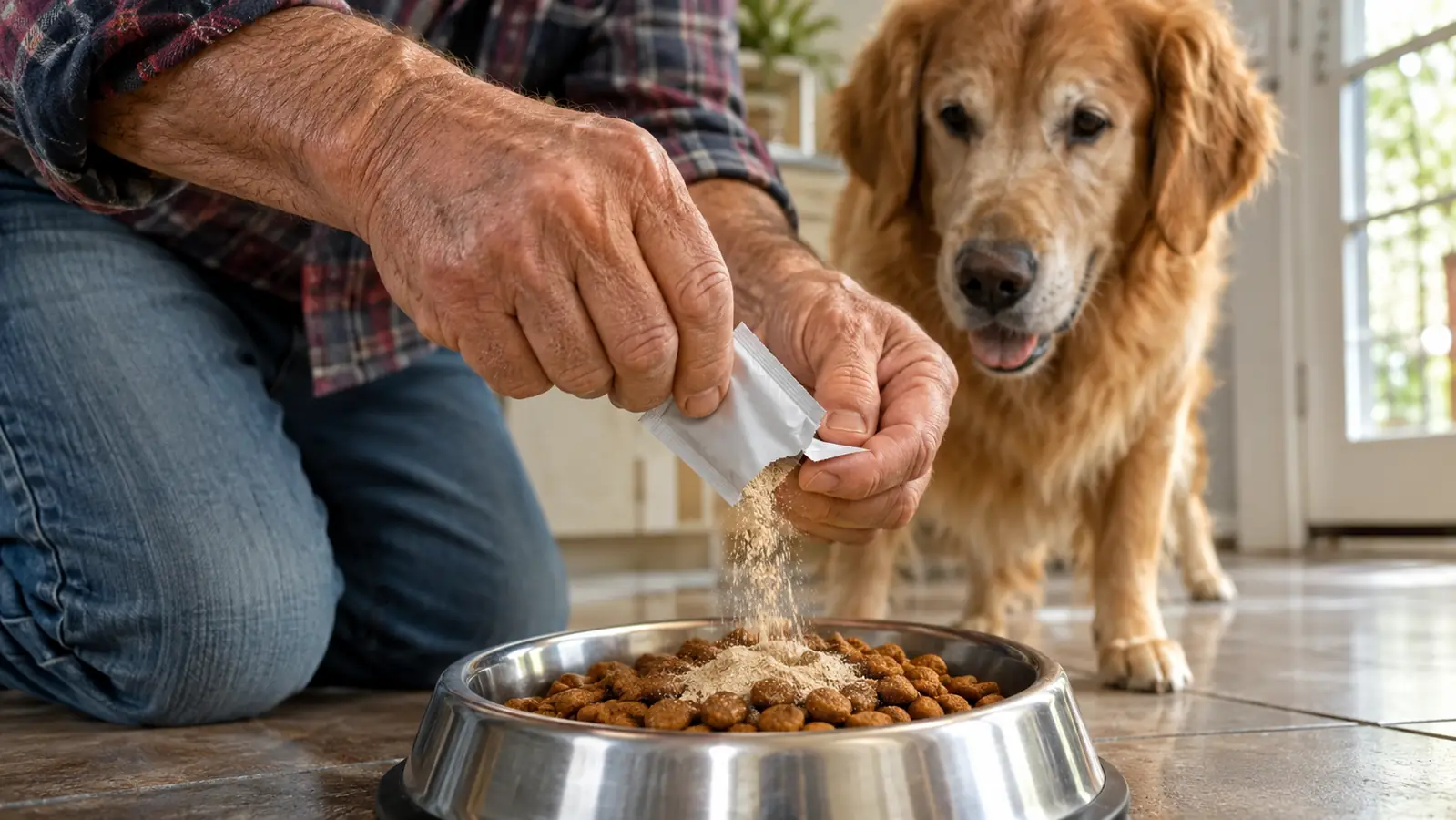
Rosie is not a subtle animal, but she can nose a tablet out of kibble with more patience than I have. Powder goes into the food and stays there. The ingredient list includes liver flavor, and she licks the bowl clean, which is the closest thing to a review a dog can offer. No peanut butter negotiation at seven in the morning, no tablet rolling under the stove, no wondering whether she actually got any of it.
One sachet on dinner, and that is the whole routine
There is no scoop, no taper, no arithmetic. Tear one sachet, sprinkle, set the bowl down. When you are already running a joint chew at breakfast, a dental chew after the evening walk, and an oil pump in between, the thing that survives a busy week is the thing with one step. Follow the label, confirm the amount with your vet, and keep the routine boring enough that you will actually keep it.
Vets name this brand more than any other for digestive support
The label states it is the number one vet-recommended probiotic brand to support digestive health, based on an online survey among United States veterinarians who named a brand. A survey is a survey, and I read it that way. Still, there is practical value in the name. When I mentioned FortiFlora, Dr. Patel knew exactly what I meant and did not have to look it up. Pro Plan Veterinary Diets is a name that shows up in clinics, and that shortens the conversation when you are already worried.

Thirty sachets is roughly the length of a bad spell
One box holds thirty sachets, so a daily sachet carries you about a month. That happens to match how long our vet wanted before deciding whether it was helping. It also means you are not buying a six-month supply of something your dog has tried for four days. Finish the box, then call and report what you saw. That is a cleaner experiment than a subscription and a hunch.
It is labeled for puppies through seniors
The same box covers puppies and adult dogs. That matters more than it sounds. Stomach trouble that starts at eight months is a different puzzle than stomach trouble that starts at nine years, but the first thing a vet often reaches for either way is managing the diarrhea while the cause gets sorted out. A young dog with a loose week and an old dog with a loose week are running the same first experiment, with two different vets watching.
The box rides in the glove box without complaint
The whole thing measures about three inches by two and a quarter by three and a quarter, and weighs a hair over an ounce. A few sachets live in the glove box of my Outback next to the spare leash, and the rest stay in the pantry. When we drive up to Charlotte to see my daughter, Rosie's dinner travels with its own small insurance policy in a ziplock bag.
There are antioxidants in it, which is a small bonus
The listing mentions immune-supporting antioxidants alongside the probiotic. I would not buy it for that line, and I would raise an eyebrow at anyone who does. The reason to use this is the diarrhea management. But it is one less thing to add to the bowl, and after a rough week a dog's system is not at its best. Small bonus, honest framing, no promises past that.
It gives you something to try that is not another food change
The last time Rosie's stomach went sideways, my instinct was to switch her food again. Dr. Patel pointed out that a fast food change is itself a common cause of loose stools, so doing it in a panic can make the week worse. A probiotic is something you can add without turning the whole bowl over. It bought us the time to move her kibble slowly, over ten days, the way I should have done it the first time.
What I'd Skip
Skip this if your dog is vomiting, lethargic, running a fever, or has blood in the stool. Those are not probiotic problems. Those are call-the-clinic-now problems, and I would rather be the man who called too early than the one who waited until Thursday. Skip it as a substitute for a diagnosis, because a probiotic will not fix a food allergy, a parasite, or a swallowed sock. Skip the forum dosing entirely. Follow the label, ask your vet, and if things have not turned around in a few days, stop guessing and go in. And skip the idea that this replaces a careful feeding routine. It does not. It buys you room to get that routine right.
The strain is printed on the label. That alone puts FortiFlora ahead of the powders that just say probiotics and hope nobody asks a follow-up question.
Keep one box in the pantry before you need it
FortiFlora is made by Pro Plan Veterinary Diets and comes as thirty sachets to a box. One on dinner, a call to your vet first, and a note on the calendar to check back in a month. That was the whole plan at my house, and it still is.
Amazon Check today's price on Amazon →