

Rosie is nine years old, sixty-eight pounds, and a yellow Labrador mix I adopted from the county shelter when she was two. For most of her life she met me at the door before I got the key out of the lock. Around her eighth birthday she started taking a beat before standing up, and through that first cold snap the beat got longer. Dr. Patel felt her hips at the age-eight checkup, said the words mild hip arthritis, and then said the thing I already half knew, which is that a glucosamine and chondroitin supplement was reasonable to try. I am not a veterinarian. I am a retired physical therapy aide who spent thirty years watching bodies move badly and then move better.
That is the whole reason I said yes to trying it. In my old line of work, the people who improved were rarely the ones who found one dramatic thing. They were the ones who did a small, boring thing every day for a year and let it stack. So I bought a bottle of Nutramax Cosequin chewable tablets, wrote the label amount for her weight on the back of an envelope, called the clinic to confirm it, and started giving it to her with breakfast. That was about a year ago. Here is what the year looked like, including the parts that did not get better.
The Quick Verdict
Roughly six to eight weeks in, Rosie stopped pausing before she stood up and started taking the porch steps like a dog with somewhere to be. It does not touch the cold January mornings and it treats nothing. It is a supplement that earned its place on my counter.
Amazon Check Today's Price →The bottle that survived a full year on my kitchen counter
Chewable tablets with glucosamine and chondroitin, taken like a treat by a dog who is suspicious of everything else. Check today's price, then confirm the amount for your dog's weight with your own vet before the first one goes in the bowl.
Amazon Check Today's Price on Amazon →How I've Used It
The label lists a daily amount by weight and I am going to be careful here, because I am not qualified to tell you what your dog needs. I read the label, I wrote the number down, and I called Dr. Patel to confirm it. She said the amount was right for a sixty-eight pound dog and to give it with food. Then I did that same thing every morning for a year, which is the entire method. There is no clever trick to report, and I would be wary of any review that offers one.
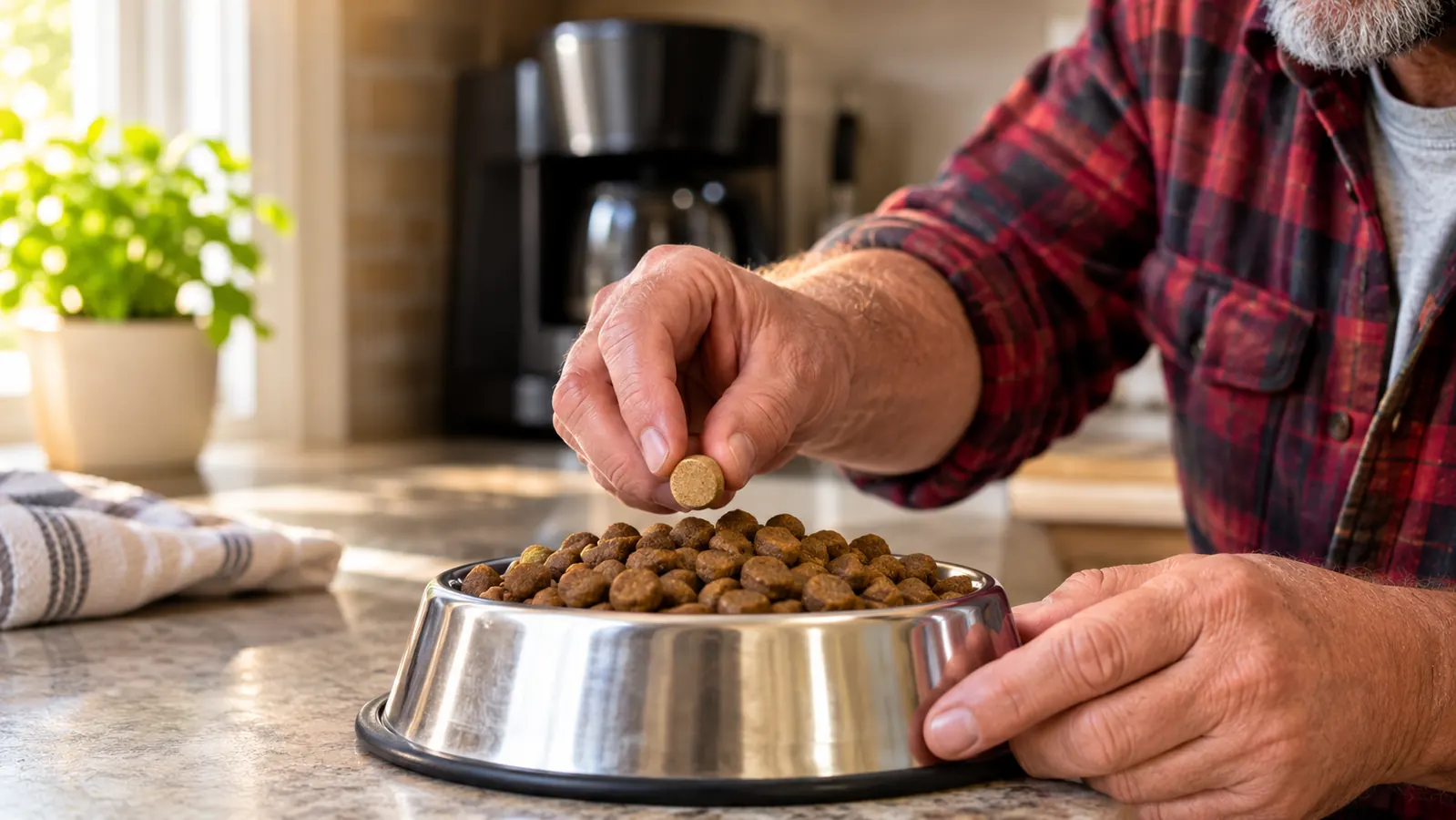
Rosie takes hers like a treat, and honestly that is half of why this stuck. I have tried powders she could smell from across the kitchen and pills I had to bury in peanut butter and then stand there watching to make sure they went down. The chewable goes in about four seconds and she looks up afterward for a second one that does not come. A dog who will not take a supplement is a supplement that does nothing, no matter how good the label reads.
The Nutramax bottle lives on the counter beside the coffee maker, which is the only reason I remember it exists. In a cabinet I would lose track by Thursday. I have reordered it enough times that it is just part of the grocery list now, sitting there between the coffee and the kibble. That is a dull detail and it is also the most important one in this review, because consistency is the whole mechanism with something like this.
What's Actually in the Tablet
The label lists glucosamine hydrochloride, sodium chondroitin sulfate, and MSM. Nutramax Laboratories leans hard on the fact that the glucosamine is a specific form they call FCHG49 and the chondroitin is TRH122, and Nutramax has been making pet health products for over 25 years. The product listing describes Cosequin as the number one vet recommended retail joint health supplement brand. I cannot verify a ranking like that from my kitchen in Hendersonville. What I can tell you is that when I asked Dr. Patel which brand she would point me toward if I was going to try this at all, this was the name she said, and she said it before I finished the question.
Glucosamine and chondroitin are the two things most studied for joint support in dogs, and the research is mixed and modest. They are not anti-inflammatories. They will not do what a prescription pain medication does, and nobody should expect them to. What they may do is support the cartilage and the fluid in the joint over a long stretch of months. That word, months, is the one to hold onto. Nothing in this category is fast, and the products that promise fast are selling you something else.
MSM is the third ingredient and it turns up in a lot of human joint products too. I will not pretend I can separate out what the MSM contributed from what the other two did over a year of mornings. I tested the tablet as a whole, so that is how I am reporting it. If you want a breakdown of each ingredient in isolation, this is not that review and I am not the man to write it.
What Changed, and When
Nothing happened in week one. Nothing happened in week three. I want to be plain about that, because I have read reviews claiming a difference in five days, and either those dogs were different or the difference was something else entirely. For the first month and a half I was fairly sure I was paying for optimism and a nicer looking counter.
Somewhere around six to eight weeks in, I noticed she was getting up from her bed without the little pause. Not every single time, but more mornings than not. The other change was the porch steps, three of them down to the yard, which she had started taking one at a time with a small hitch on the last one. She began taking them like a dog with somewhere to be.
I started writing it down, which sounds fussy and is the reason I can tell you any of this with a straight face. Three words in a notebook by the coffee maker most mornings: easy, slow, or stiff. Six weeks of stiff, then a stretch of slow, then more easy than I expected. Memory is a poor witness for gradual change. A notebook does not flatter you.
That is the entire list of what I can honestly claim. Less hesitation standing up, easier porch steps, and a dog who seemed more willing to walk to the end of the driveway. The morning loop by the French Broad is a slow mile and it stayed a slow mile. She was not suddenly a younger dog. She was a slightly more comfortable old one, and at nine years old that is the realistic version of a good outcome.
It did not cure anything. On a January morning she still takes four or five stiff steps before her gait loosens. She just does it without the long pause first, and that pause was the thing I noticed most.
What It Didn't Fix
Cold mornings still get her. In January there are days she stands up stiff and needs four or five steps before her gait loosens, tablet or no tablet. I have stopped expecting otherwise. Arthritis is not something a chew fixes. It is something you manage, and management has a floor under it that no bottle gets you past, no matter what the reviews on the listing say.
It did nothing for her itchy late summer skin, which is a separate problem with a separate answer. It did nothing for the tartar on her back teeth. It did nothing about the fact that she is nine and sleeps more than she used to, which is not a problem at all, just a fact about a dog getting older. I list those on purpose. A supplement review where everything improved is a review written by somebody who was not paying attention.
And the Nutramax bottle is a real line item in the monthly budget, not a rounding error. I am not going to quote you a number because prices move around and mine is not yours. It is worth deciding on that on purpose rather than tacking it on and forgetting about it. For us it earned the spot. It earned it in a quiet way, over months, not in a dramatic one.
What I Liked
- Rosie takes the chewable like a treat, so there is no daily negotiation
- Around six to eight weeks in, she stopped pausing before she stood up
- The porch steps got noticeably easier, which I did not expect
- A brand my vet named before I finished asking the question
- One bottle on the counter fits the routine, so I actually remember it
Where It Falls Short
- Nothing visible for the first month and a half
- Still stiff on cold January mornings, every year, no exceptions
- A real monthly cost for a supplement, not a treatment
- Does nothing for itchy skin, tartar, or the general fact of aging
- Worthless if your dog will not eat a chewable and you will not be consistent

The Habits That Did as Much as the Tablet
Here is the part my old job taught me. A supplement layered on top of a bad setup is a supplement doing less than it could. Two things changed in this house around the same time, and I would be lying if I gave the tablet credit for all of it.
The first was the floor. The hallway and kitchen are hardwood, and last winter her back legs splayed out from under her on the hallway turn. That is not a joint supplement problem, that is a traction problem. I measured her paw, bought non-slip socks that actually fit, and she wears them indoors in the mornings and evenings. She pulled one off twice that first week and now ignores them entirely. The difference on that hallway turn showed up within a day, in a way the tablet never did.
The second was the walk. The advice that mattered more than any bottle was keep her moving and keep her lean. A sixty-eight pound Labrador who puts on five pounds is carrying five extra pounds through two complaining hips, and every step costs more than it did. We kept the slow mile. On the bad mornings we did a shorter slow mile and called it done.
I mention both because I do not want anyone reading this to buy a chew and skip the floor and the leash. The tablet was one of three things. It was also the one I could not measure as easily, which is exactly why I waited a year before writing any of it down for anyone else.
What to Ask Before You Start
Bring the bottle, or a photo of the label, to your next appointment. Ask three things. First, whether a joint supplement is reasonable for what is actually going on in those hips, or whether you are past that and into something prescription. Second, what amount fits this dog's weight and whether it needs to go with food. Third, what should make you call back instead of waiting another two weeks.
That third question is the one I would not skip. You want a clear line in your head between a dog who is stiff and a dog who is in trouble. Ours was simple: if she stopped eating, stopped wanting the walk, or yelped when I lifted her, we were in the car and headed to the clinic. A supplement is not a reason to delay that call, and it is not a substitute for a diagnosis.
Ask about weight while you are there. Every conversation I have had about Rosie's hips came back to the same number on the scale, and it is less satisfying than buying something. It also does more.
Who This Is For
This is for the owner of an older dog who has had the hips looked at and been told the arthritis is mild or moderate. The dog who stands up slowly, takes the stairs carefully, and is stiff after a long nap on the rug. It is for someone willing to give it eight weeks before deciding, and to keep the dog moving and lean in the meantime. If your vet has already suggested a joint supplement, this is a reasonable one to hold up and ask about by name.
It also helps if your dog is food motivated. Rosie would eat a gravel if I put it in her bowl, so the chewable was never the hard part. A dog who turns her nose up at them will turn this into a daily negotiation, and a daily negotiation is the thing most of us quietly quit by February.
Who Should Skip It
If your dog is limping, yelping when picked up, refusing to rise, dragging a back leg, or has gone off food, skip the supplement aisle and go to the clinic. Those are not supplement problems. A sudden change in a dog's ability to move needs a diagnosis from someone with an X-ray machine, not a chew from a man with a notebook.
Skip it if you want something that works this week, or if you know in your bones you will not be consistent. And if your dog is already on other medication, do not start this quietly on your own. Overlapping ingredients and interactions are a real conversation to have with somebody who has the chart in front of them.
Ask about the hips at your next exam. Then ask about this.
Glucosamine, chondroitin, and MSM in a chewable a picky dog will actually eat. Nutramax is the name my vet gave me without hesitating, and it is the one I have reordered for a year straight. Check today's price and bring the label to your appointment.
Amazon Check Today's Price on Amazon →