
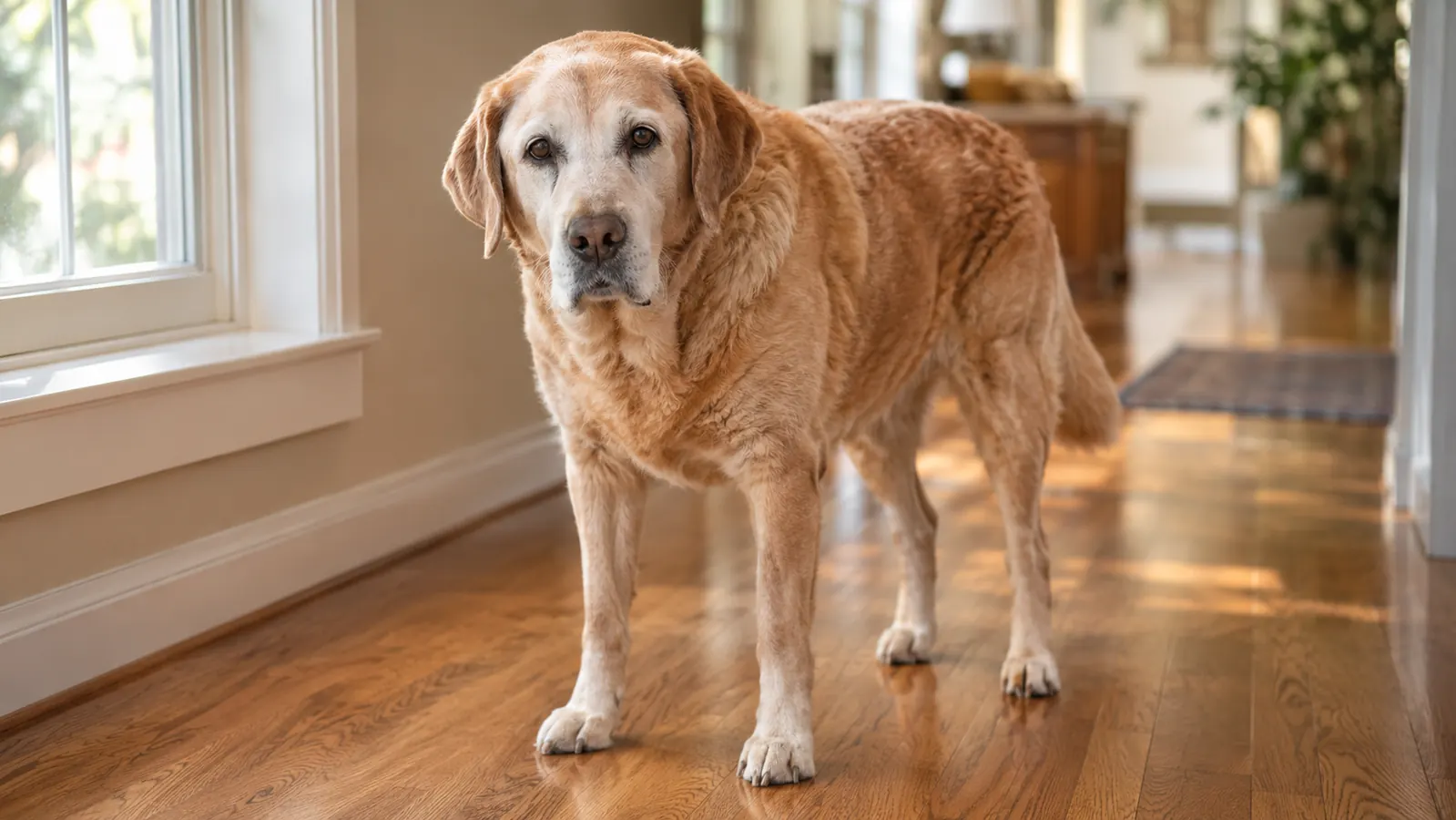
Rosie's back legs slid out from under her in the hallway last winter. Not a fall, exactly. More of a slow splay, her rear paws traveling outward on the oak until she was sitting in a way she had not planned to sit in, looking back at me as though I had arranged the whole thing. She is nine, a yellow Lab mix, about 68 pounds, adopted from the county shelter when she was two. Dr. Patel noted mild hip arthritis at her age-eight checkup. Nothing dramatic, and nothing that called for anything dramatic. But a dog that age, in a one-story brick ranch with original hardwood through the whole front of the house, has a traction problem, and I had been politely ignoring it because the floors are pretty and she is stoic about everything.
Before the DOK TigerToes, I tried the obvious fixes. Carpet runners down the hallway, which helped for a week and then migrated an inch a day until they were bunched at the far end. A cheap set of socks from a big-box store that turned into anklets before lunch. Stick-on grip pads on her paw pads, which lasted about as long as you would expect and took some hair off with them. None of it was foolish. None of it stayed put. So I measured her front paw flat on the kitchen table with a tape measure, checked the size chart twice, and ordered the TigerToes in Large. That was last winter. She has worn them most mornings and most evenings since.
The Quick Verdict
Four socks that stay on a big dog, and a grip that still bites the floor after the sock rotates. The twist is the whole point, and it holds.
Amazon Check Today's Price →The hallway stopped being the part of the morning I worried about
Four socks per set, size Large for paws measuring 2.5 to 2.8 inches. Machine washable cotton and nylon, with a hook and loop strap that stays put on a dog with opinions.
Amazon Check Today's Price on Amazon →How I've Used Them
Rosie wears the socks indoors, on the hardwood, in the morning and again in the evening. Never on the walking trail by the French Broad River, never out in the yard, never overnight. That is not a limitation I discovered the hard way. It is what they are for. Wet grass and gravel grind down any fabric grip pad, and a dog sleeping in socks is a dog wearing a damp sock by two in the morning. The DOK set is the third thing I bought for this problem and the only one still in the rotation.
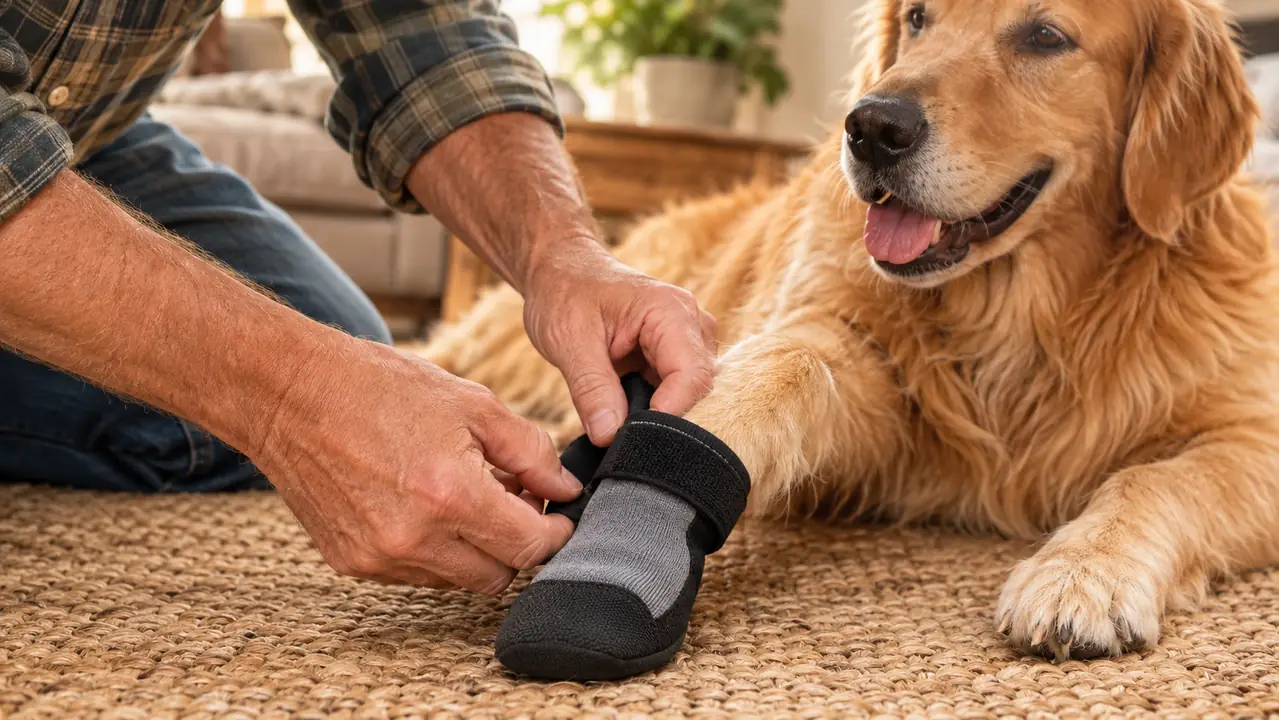
The routine is short. She stands at the end of the hallway, I kneel down, and the four socks go on front paws first because she is more patient about the front ones. Hook and loop strap, snug but not tight, then a quick check that the grip pad is sitting under the paw and not off to the side. Sixty seconds on a good day. Three minutes on a day when a squirrel is visible through the front window.
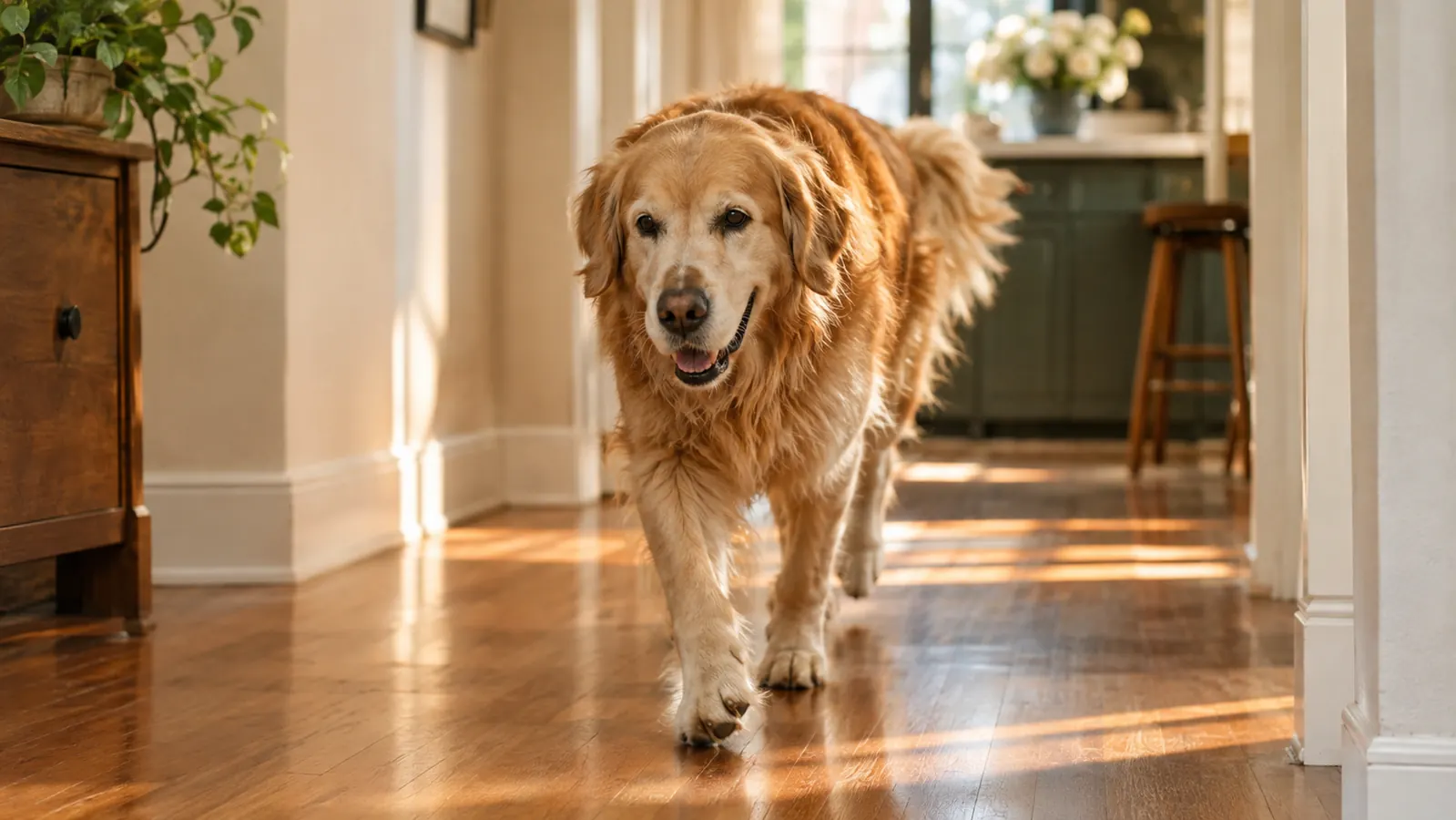
Then she does her circuit. Kitchen, hallway, living room, back to the kitchen, the same loop she has walked for seven years, except now her nails do not skitter on the turn by the coat closet. I take them off before her afternoon nap on the rug, mostly because she likes to work at her back feet while she settles and I would rather not test the strap against a dog with nothing else on her schedule.
The socks come off before her evening meal too, and I check the pads against my palm before I set them by the door. The first week I set a kitchen timer for twenty minutes, because I had no idea how long she ought to wear them and did not want to leave a dog standing around in socks all evening. Twenty minutes turned out to be about the length of her circuit anyway, so the timer came out of the routine and the habit stayed.
The Grip, and Why the Twist Matters
Here is what I did not understand about dog socks until I owned a set. The failure mode is not the grip wearing out. It is rotation. A sock turns on the paw, the grip pad migrates from the bottom to the side, and now your dog is walking on smooth cotton with a rubber patch facing the baseboard.
DOK builds this set around that problem. The grip is extra thick and the listing says it works even when the sock twists. I was skeptical of that sentence, because every listing has one sentence like that. Months in, I will say it is the most accurate line on the packaging. When Rosie's front left rotates, which happens maybe once a day, she keeps her footing. The pad is thick enough that even the edge of it catches the oak. I straighten it when I notice. She does not care either way.
Concretely: the pad under her right front paw has flattened in the middle and stayed proud at the edge, and that edge is what catches the oak when the sock turns. A pad that wore perfectly flat and even would lose that. The set I bought off a pet store shelf before these had a thin pad that was gone, worn through to the fabric, in about six weeks.
The pad itself is holding up. It has flattened a little under the two paws that carry most of her weight, which is what rubber does. It has not peeled at the edges, which is what cheap rubber does.
Sizing, Straps, and Getting Four Socks on a 68-Pound Dog
Size Large covers paws measuring 2.5 to 2.8 inches, and that is the number that matters. Not the weight on the bag, not the breed on the chart. Measure the paw with the dog standing, because a paw spreads when it takes weight and a measurement taken lying down runs small. Rosie's front paws measured just over 2.5 inches. The Large fits with a little room at the ankle, which is what you want. A sock that fits like a tourniquet is worse than no sock at all.
I nearly ordered a size down, out of caution, because she is 68 pounds and not a giant. That would have been a mistake. On a paw measuring just over 2.5 inches, a smaller sock would have pulled on but the cuff would have sat low on the ankle, and the strap needs room above the joint to do its job. The Large was right, and if I ordered a second set I would measure her again rather than guess from the last order.
The closure is a hook and loop strap over a pull-on sock, and that combination is why these stay on. The strap sits above the ankle joint, tight enough to hold, loose enough that I can still slide one finger underneath. If I cannot get a finger under it, it is too tight, and I take it off and start over.
The first week, she pulled one off with her teeth twice. Both times it was the back right, both times within the first ten minutes, and both times she looked at me with the flat satisfaction of a dog who has solved a puzzle. By the second week she stopped bothering. I do not know whether the novelty wore off or she decided the socks were simply part of the morning, but at some point a dog stops negotiating with the thing that stands between her and breakfast.
Months of Wear: What Held Up and What Didn't
I wash these every week, sometimes twice, and they have been through a mountain winter and a Hendersonville summer. The cotton and nylon have not pilled badly. One seam on the back left loosened around month four and I trimmed the thread; it has not opened since.
By the end of that winter, which for us means ice on the porch steps from January into March, the set had been through about thirty washes. I counted once, out of curiosity, because the mesh bag hangs by the machine and every wash goes in the same bag. Thirty washes on cotton and nylon with a hook and loop strap, and the strap still holds. That is the number I would want to know if I were reading this instead of writing it.
What wore: the grip pads flattened, as I said. The elastic at the cuff on the pair she pulls at most has relaxed a little, which means the strap does more of the work than it did in January. Nothing has torn through, and I have not thrown a sock away. Four to a set means one can be in the laundry while three are on the dog, which turns out to be the single most practical thing about buying a set of four instead of a pair.
What did not wear: the strap. I expected the hook and loop to go fuzzy and quit gripping after a couple dozen washes. It has not, and I check it every time I fasten one because a strap that lets go at the wrong moment is the only real failure this product could have.
The Licking, Which I Did Not Expect to Matter
The listing mentions that these help with licking, and I read past that on the first pass. Then I noticed the thing I had stopped noticing. Rosie used to spend a good ten minutes after every nap working at her back feet, licking and nibbling at the same two spots. With socks on, she cannot get the same purchase. She gives up after a minute and goes back to sleep.
I want to be careful here, because this is the kind of observation that turns into a claim if you let it. Disrupting the licking is not the same as fixing whatever drives it. If your dog is licking a paw raw, that is a vet question, and it was a vet question for us too. What the socks did was break a habit loop long enough that the skin on her back feet got a rest. Dr. Patel looked at it at her last visit, said the skin looked fine, and told me to keep doing what was working.
Washing Them and the Small Daily Annoyances
Machine wash, and I put them in a mesh bag with the rest of her laundry so the strap does not grab a towel and stretch itself out. Cold water, regular detergent, air dry over the back of a kitchen chair. They come out soft and a touch smaller the first time, then they stop. I would not put them in a hot dryer, and I would not wash them loose with a load of jeans.
The annoyances are small and real. A sock twists and needs straightening most days, and if I am rushing I do not notice until she is halfway down the hall. Damp paws and fabric do not mix; if she comes in from the yard with wet feet I dry them first or the sock goes on crooked and stays that way. And there is nothing dignified about kneeling on a hardwood floor at 6:40 in the morning explaining to a Labrador that we are almost done.
What I Liked
- Extra-thick grip still bites the floor after a sock has rotated halfway around the paw
- Hook and loop strap holds on a dog who pulled a sock off with her teeth in week one
- Machine washable cotton and nylon, four to a set, so one can be in the laundry
- Size Large fits paws measuring 2.5 to 2.8 inches, which covers most Lab-sized dogs
Where It Falls Short
- A sock still rotates now and then and needs a straightening
- They are indoor traction, not footwear for rough ground
- Getting four socks onto a 68-pound dog takes two hands and some patience
A twisted sock still grips. That sounds like a small thing until you have watched your dog's back end decide whether to commit to the hallway.
Who This Is For
This is for the owner of an older, bigger dog in a house with hard floors. The dog who hesitates at the top of a step, or scrambles getting up from a nap, or takes the turn into the kitchen a little wider than she used to. If you have watched your dog's back end slide out on a slick floor and felt your stomach drop, these address exactly that. Size Large covers paws in the 2.5 to 2.8 inch range, which is where most Lab-sized dogs land, and measuring is the whole trick.
It is also for the owner who already tried the cheap version and watched a sock roll into a doughnut by noon. The strap and the thick grip are the difference. Neither one is complicated. They are just built to hold, and holding is the entire job.
Who Should Skip It
Skip these if your dog needs a boot for rough ground, sharp gravel, or salted sidewalks in February. The socks give traction and they cover the paw, but they are socks. I do not send Rosie down the trail in them and I would not send yours.
Skip them if you are not going to be the one kneeling down twice a day. A dog cannot put these on herself. If your hands are not up to the strap, or if your dog cannot be handled around the feet without a struggle, talk to your vet or your groomer about what else might work, because a sock that goes on crooked is a sock that comes off in the hallway.
And skip them if you are hoping they will do something about the arthritis itself. They will not. They change the floor, not the joint. Rosie is stiff on cold mornings whether or not she is wearing them. The socks are one part of a routine that also includes her joint supplement, her weight, and the slow mile by the river. Anything past that is a conversation with Dr. Patel, not a conversation with a sock. If your dog is newly lame, or dragging a foot, or knuckling over, that is a vet visit first and a purchase second.
Four socks, one dog, and a hallway that stopped being a hazard
Size Large fits paws measuring 2.5 to 2.8 inches. Machine washable cotton and nylon with a hook and loop strap, and an extra-thick grip that keeps working after the sock rotates.
Amazon Check Today's Price on Amazon →