
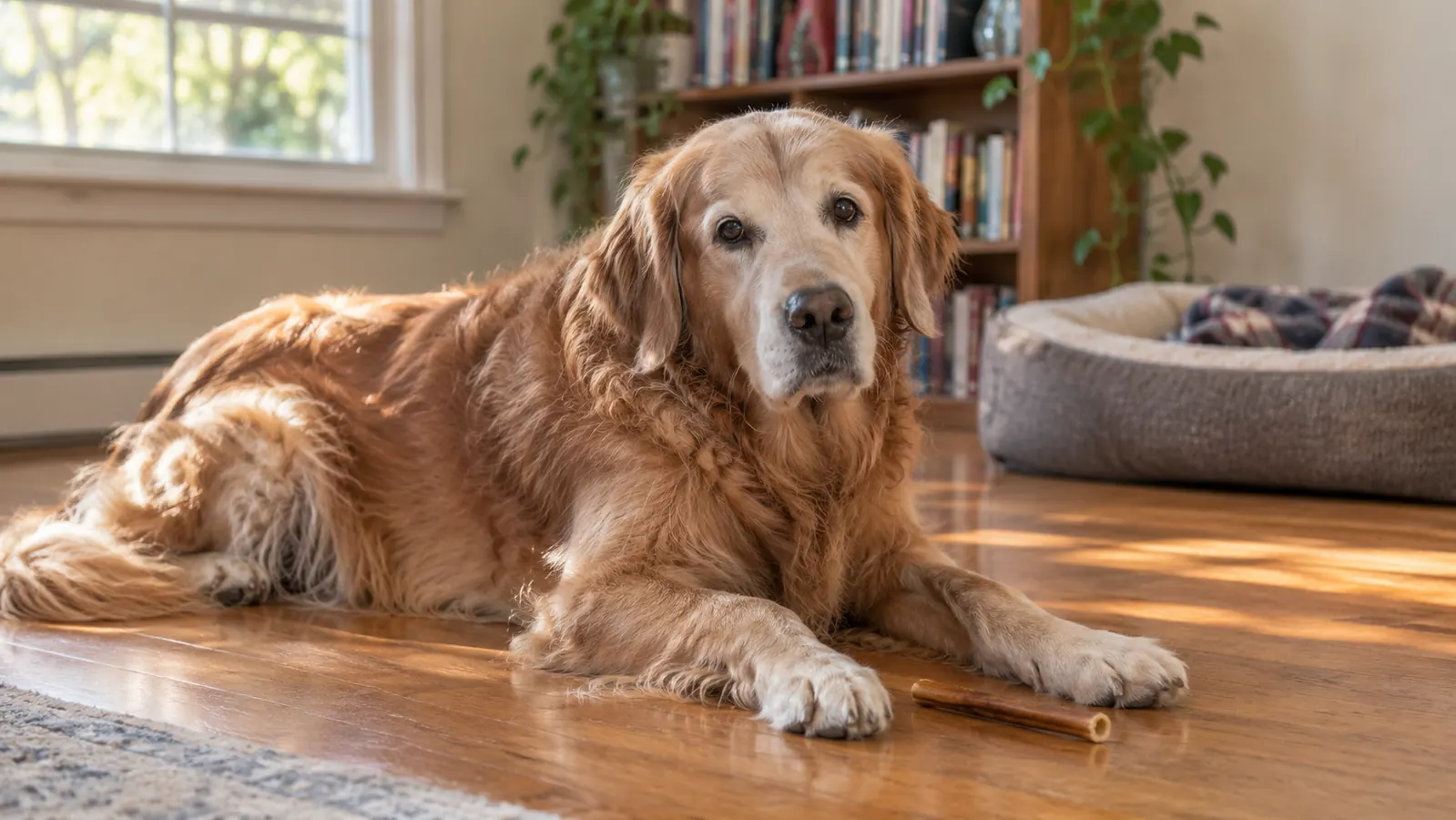
Rosie turned nine in March. At her checkup, Dr. Patel wrote down the same two notes she had written the year before: mild arthritis in the hips, and tartar building on the back molars. The hips we were already handling. The tartar was the part I had been ignoring, mostly because I did not want to think about what fixing it would involve.
That is how a pouch of Greenies Large ended up in my pantry about eighteen months ago. Not because I read a study and got excited. Because a dental cleaning under anesthesia for a sixty-eight pound Labrador mix sounded like a bigger decision than I wanted to make on a Tuesday, and our vet said a daily dental chew was a reasonable thing to start while we kept an eye on the tartar. She was clear it was not a substitute for the cleaning. She was also clear it was worth doing. I am not a veterinarian and I am not going to pretend to be one. I spent thirty years as a physical therapy aide, which mostly taught me that bodies change in small increments and that the people who do best are the ones paying attention to those increments over months instead of waiting for one dramatic fix.
The Quick Verdict
A daily chew that earned its place in my routine. Her breath improved within a few weeks and her back teeth looked cleaner at the next checkup. It has not replaced her yearly dental exam, and it will not fix teeth that already need work.
Amazon Check Today's Price →Eighteen months of one chew after the evening walk
This is the exact size and flavor that has lived in my pantry since Rosie's last checkup. If your dog sits in the fifty to one hundred pound range and your vet has mentioned tartar, this is where I would start.
Amazon Check Today's Price on Amazon →How I've Used It
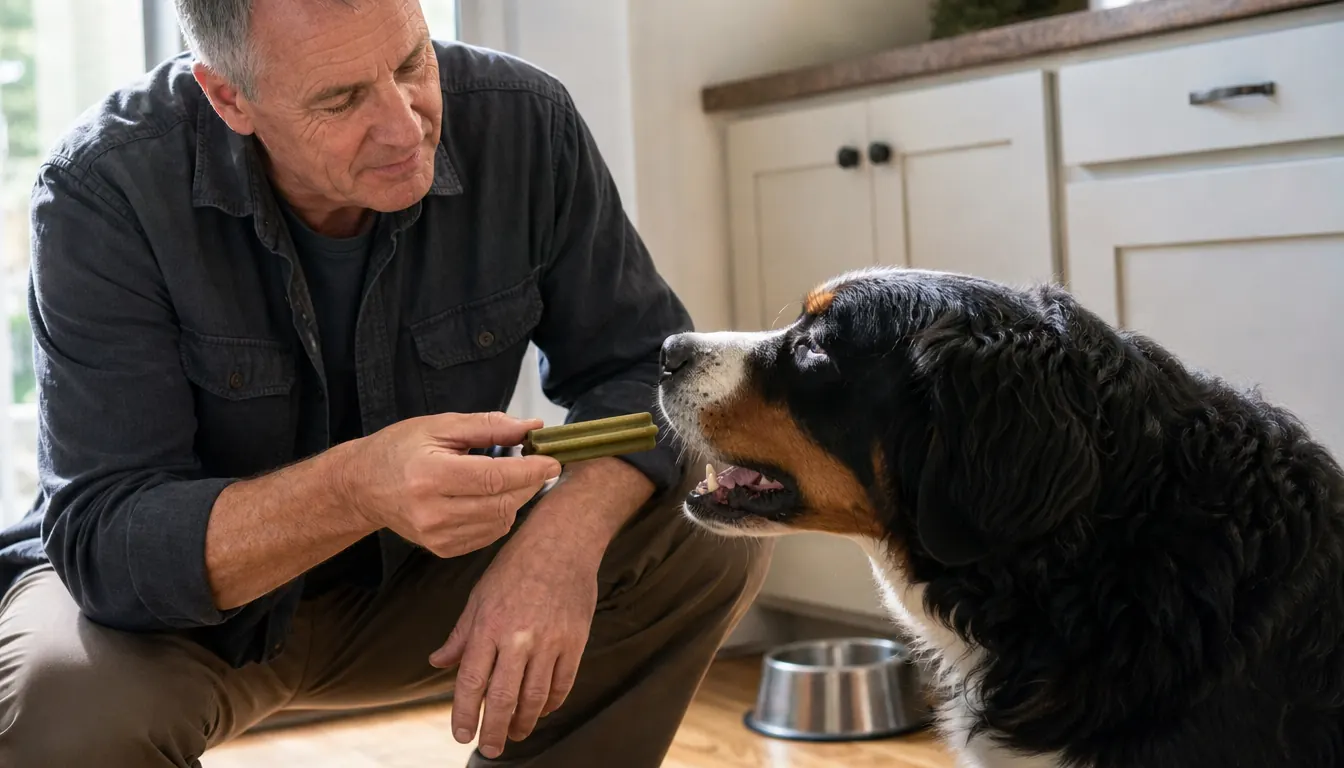
Rosie gets one Greenies Large after her evening walk. That is the whole routine. We do a slow mile most mornings on the trail by the French Broad River, and the evening one is just around the block, but either way the chew comes after, when she is already settled and I am already standing in the kitchen.
One a day, every day, for about eighteen months. I have missed a handful of days in that stretch, usually when we were traveling and I forgot to pack them. I watch her while she works on it, which is no hardship since she takes it to the same spot on the rug every time. And I count it as part of her treats for the day, not as something extra stacked on top. That last part matters more than people think. A sixty-eight pound dog does not need a bottomless treat budget, and this is a real piece of food, not a nibble.
She has never turned one down. She is not a picky dog, but she is also not a dog who finishes everything you set in front of her, and she finishes these. The size question comes up a lot, so here it is plainly: Large is built for dogs from fifty to one hundred pounds. Rosie is sixty-eight, which puts her near the middle of that band. The pouch I buy holds twenty-four, which works out to about three and a half weeks at one a day. When I am getting low I order another, because the day I run out is not the day I want to be making decisions.
Before any of this, I tried a toothbrush. I bought the dog toothpaste and the little angled brush and I got maybe four honest sessions out of it before Rosie decided she had opinions. She was polite about it. She would clamp her jaw, look at the wall, and wait me out. I tried again every few weeks for about two months and the same thing happened every single time. If your dog tolerates brushing, then honestly, brush. That is better dental care than any chew on a shelf, and I will say that in every conversation about this. Mine does not tolerate it, and I got tired of losing an argument to a dog at nine o'clock at night.
What's Actually in a Greenies Large
The ingredient list is short and readable, which I appreciate more than I used to. Wheat flour first, then gelatin, glycerin, and natural poultry flavor. The listing says no artificial flavors, and it says rawhide-free, which was the detail that mattered most to me. I watched enough dogs gag on rawhide over the years that I stopped buying it long before any of this came up. A chew that softens and breaks down is a different proposition from one that does not.
The Greenies pitch is about the mechanical work of chewing rather than anything chemical. That lines up with what our vet told me. Chewing scrapes. Scraping helps. It does not reach between the teeth or below the gumline, and no chew on the market does that, which is exactly why the professional cleaning still exists as a thing you can pay for.
The other thing worth saying plainly: this is a food product with calories in it, not a plastic toy. If your dog is carrying extra weight, or if your dog is on a prescription diet, that is a conversation to have with your vet before you add a daily chew of any kind. I asked, and Dr. Patel adjusted what Rosie gets at meals to account for it. Nothing dramatic, just a small subtraction at dinner.
What Changed and What Didn't
The breath change came first. Within about three weeks I noticed I could sit beside her on the couch without that particular smell. That is not a small thing when the dog sleeps at the foot of your bed. It was the kind of improvement that sneaks up on you, where one evening you realize you have stopped noticing something, and then you realize the reason you stopped noticing is that it is gone.
There was one evening in particular, somewhere in that first month, when it actually registered. We were on the couch, she had her head on my knee the way she does, and her breath registered as nothing at all. No turning my head. No making a face. That is the whole review, if I am being honest with you. Not a dramatic before and after photograph. Just the quiet disappearance of a small daily unpleasantness I had gotten so used to that I had stopped counting it as a problem. Everything else in this piece is context for that one moment on the couch.
At her next checkup, Dr. Patel looked at the back molars and said they looked better than she expected. She still noted tartar. She still wants to see Rosie every year for a dental exam, and at some point we are probably going to be talking about a cleaning again. But eighteen months of a daily chew bought us time and, more useful than that, it built a habit I can keep doing without thinking about it.
What it did not do: her hips are no different, which should go without saying but apparently needs saying. It did not change her weight. It did not change her coat. It did one thing and it did that one thing well, which is all I ask of anything living in my pantry. If you want the longer version of why chewing matters as a dog gets older, that is a separate conversation, but the short version is that an older dog stops working at things unless you give her something to work at.
The Chewing Time Question
Here is the part I would put on the label if I were in charge. How long your dog takes to finish one matters more than almost anything else about this product. Rosie takes a good few minutes, working it down from the ends, and I can watch her do it without worrying. A dog who swallows a chew like this whole is a dog who should not be getting one in this size, or possibly not in this form at all.
The general guidance is to match the chew to the dog's weight, and Large is the fifty to one hundred pound band. Weight is a proxy, though. I know a hundred pound dog who eats like a bird and I have met forty pound dogs who inhale anything you hand them. If you are unsure, watch the first several. If your dog is a gulper, ask your vet whether any chew is a good idea, not just this one. That is not me dodging the question. It is genuinely a dog-by-dog answer.
I timed Rosie once, purely out of curiosity. Two minutes and forty seconds on the porch, working steadily from one end. A friend's dog, roughly the same size, does the same chew in about ninety seconds and then stands there looking for more, which tells you most of what you need to know about whether a chew is doing anything for that particular dog. There is no universal number and I would not trust anyone who gave you one. The real question is whether your dog is working at it or swallowing it. One is dental care. The other is just a snack with a shape.
I also do not leave Rosie alone with one. That is my own rule and it costs me nothing, since the evening walk is over and I am in the house anyway. It is worth saying out loud because a treat you hand over and walk away from is a different risk from a treat you sit and watch. Same product. Different level of attention.

The Tradeoffs I've Run Into
The obvious one is that this is an ongoing habit. One chew a day means a new pouch every three and a half weeks, indefinitely, and that is a standing commitment rather than a one-time purchase. I have decided it is worth it for us. Someone else could reasonably decide that brushing three times a week is worth more of their effort, and they might be right. The best dental routine for a dog is the one the owner will actually keep up with.
The second is that wheat flour and gelatin are the first two ingredients. Some dogs do fine with wheat and some do not, and if your dog has a history of food sensitivity, this is exactly the kind of thing to run past your vet before you start. Rosie has a sensitive stomach and has had no trouble with these, but that is one dog, not a rule, and I would not want anyone to read my experience as a guarantee about theirs.
One small thing nobody mentions: the pouch has a smell. Not an offensive one, but a distinct one, and if you keep it in a closed cabinet the cabinet picks it up after a week or two. I moved mine to an open shelf in the pantry and that ended it entirely. She also leaves a damp patch on the rug where she works at it, which dries in a few minutes and has never marked the floor. Small stuff, all of it. But it is the kind of small stuff that quietly decides whether you are still doing something eighteen months later.
The third is that a dental chew is not dental care in the way a cleaning is dental care. Nobody should buy this thinking they have handled the problem. The way I would put it is that these are the flossing of dog dental care. Useful, real, and not a substitute for the appointment. Dr. Patel said something close to that verbatim the first time we talked about it, and it has held up over eighteen months.
What I Liked
- Her breath improved within about three weeks
- Back teeth looked cleaner at her next checkup
- Rawhide-free, with no artificial flavors
- She treats it as the highlight of her evening
- Sizing band is clear: fifty to one hundred pounds
Where It Falls Short
- One a day means a fresh pouch every three and a half weeks, indefinitely
- Wheat flour is the first ingredient, so it is not right for every dog
- Does not replace brushing or a professional cleaning
- A dog who gulps should not get this size, or possibly any chew
Her breath is better and her back teeth look cleaner at her checkup. That is a real result. It is also not the same thing as a dental cleaning, and I would not want anyone reading this to blend the two together.
Who This Is For
This is for the owner of a big dog, roughly fifty to one hundred pounds, whose vet has mentioned tartar and who wants to do something daily rather than wait for the next anesthesia appointment. It suits a dog who works at a chew instead of inhaling it, and an owner who is willing to stand there for three or four minutes and watch. It suits someone who already has a treat budget and is willing to spend part of it on something with a dental purpose rather than something purely for fun.
It also suits the owner who wants a small, boring, repeatable improvement. That is what this was for me. Not a transformation. A habit that produced a modest, checkable result, confirmed by someone with a degree rather than by me squinting at my dog's mouth in the bathroom mirror.
Who Should Skip It
Skip it if your dog has significant dental disease already, or if your vet has told you a cleaning is needed. A chew is not going to clear that up, and delaying the appointment to try is the worst version of this decision. Skip it if your dog gulps food without chewing, if your dog has had trouble with wheat or with chews in the past, or if your dog is on a weight management plan and you have not talked to your vet about the calories.
And skip it if you are not going to watch. I would rather someone buy nothing than buy this and leave a big dog alone with it because the label looked reassuring. The product is good. It is not magic, and it is not supervision.
If your vet said tartar and you want to start somewhere tonight
One chew after the evening walk, eighteen months in, is the entire method. Talk to your vet first, match the size to your dog's weight, and watch the first several go down.
Amazon Check Today's Price on Amazon →