

If your older dog is already taking Nutramax Laboratories Cosequin and getting around okay, my short answer is this: do not switch to Dasuquin just because it sounds like the next step. Switch because your vet has a reason. I say that as a retired physical therapy aide who now watches one dog's gait the way I used to watch patients cross a room. Rosie is my 9-year-old yellow Labrador mix, about 68 pounds, adopted from a county shelter when she was two. Dr. Patel found mild hip arthritis at her age-8 checkup. That is when we started Cosequin.
Rosie has been on the chewable tablets for about a year. She takes the amount the label lists for her weight, with breakfast, after I confirmed it with Dr. Patel. She eats it like a treat. Around six to eight weeks in, I noticed she got up from her bed with less hesitation and handled the porch steps more easily. She is still stiff on cold mornings. Cosequin helps. It does not cure anything. At our last visit, Dr. Patel brought up Dasuquin as an option if we ever felt Cosequin was not enough. That sentence sent me to the labels, the ingredient lists, and a notebook.
| Nutramax Laboratories Cosequin | Dasuquin | |
|---|---|---|
| What it is | A chewable joint supplement with glucosamine hydrochloride, MSM, and sodium chondroitin sulfate | The other joint supplement from the same company that my vet brought up |
| Form | Chewable tablet | A different formula from the same company, and I have not used it with Rosie |
| Daily routine | One label amount with breakfast, confirmed with Dr. Patel | A daily routine too, tied to whichever formula your vet picks |
| Simplicity | One bottle, one short ingredient list, one routine Rosie already knows | A different formula to sort out |
| Step-up option | The starting point Dr. Patel suggested for mild hip arthritis | What she would consider if Cosequin stopped being enough |
| Track record in my house | One year on it, less hesitation getting up, still stiff on cold mornings | I have not used it with Rosie |
| Best for | Mild stiffness and a dog who takes a tablet easily | A vet-recommended change or a different formula |
Before I get to the wins, one note on how I read a comparison like this. I am not a vet. I am not a vet tech. I am a retired physical therapy aide who has spent a year watching one dog's morning routine and writing down what changed. I read both labels, I asked Dr. Patel questions, and I kept Cosequin in the routine because it was working. That is the whole method. No lab coat, no sponsored test, no clipboard full of numbers I cannot verify.
The other note is about Dasuquin. I have not used it with Rosie, so I am not going to invent an experience with it. What I can compare is the role each product plays. Cosequin is the baseline we know. Dasuquin is the conversation we have not had to have yet. If your dog is further along than Rosie, your conversation may come sooner, and that is fine. The point is to have it with your vet, not with a search engine at midnight.
Where Cosequin Wins
The first win is simplicity. The Cosequin label names three active ingredients: glucosamine hydrochloride, MSM, and sodium chondroitin sulfate. I can read that list to Dr. Patel over the phone. I do not have to wonder which version of the product I bought or whether the formula changed between bottles. For a 67-year-old widower with one dog and a pill organizer of his own, that matters more than it sounds.
I keep the bottle on the second shelf beside the coffee maker with the label facing out. When the clinic calls me back about a refill, I can stand in my own kitchen and read the ingredient line without putting my glasses on twice. That is the test I run on a supplement label now: can I explain it to another person in under a minute, from memory, without guessing at anything. Cosequin passes that test. It is a low bar, and you would be surprised how many bottles in a pet store aisle do not clear it.
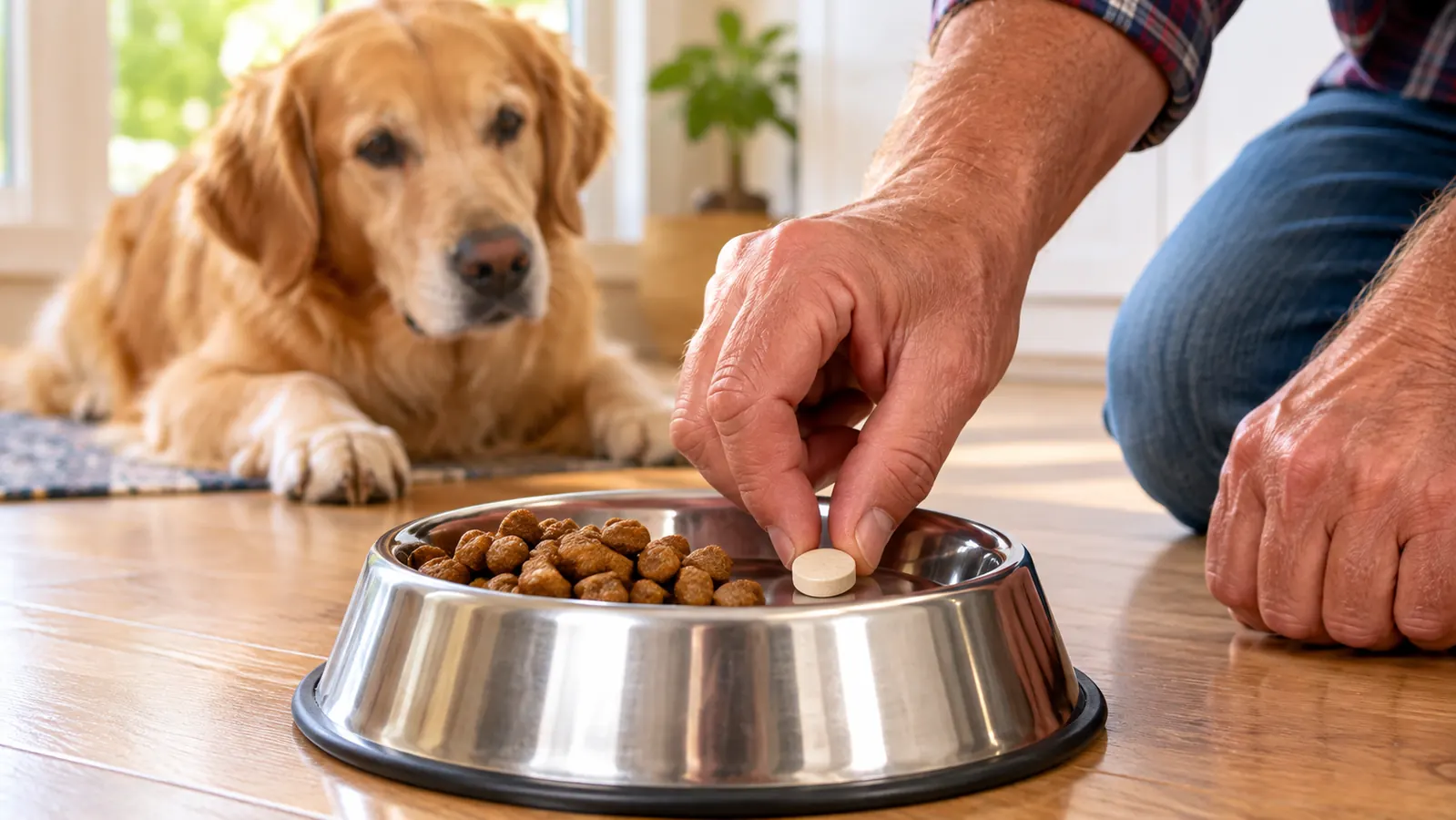
The routine is just as simple. Rosie takes her tablet with breakfast and never turns her nose up at it. It is a tablet, not a powder or a liquid, so there is no measuring and no chance of half a scoop ending up on the floor. The 132 count bottle lasts us a while, and I do not have to hide the dose in cheese. That is a small thing until you have tried to give a suspicious dog a supplement every morning for a year.
The change I noticed was not dramatic. It was the kind you notice in reverse. She stopped hesitating as long at the back door. The porch steps stopped being a negotiation. On cold mornings she still takes a few stiff steps before she loosens up. That is the honest picture. If you are looking for a product that will make an old dog young, neither Cosequin nor Dasuquin will do it. If you want a simple daily baseline that a vet can supervise, Cosequin has earned its place in my kitchen.
One morning in early March it was 34 degrees on the porch and I timed her out of curiosity. She stood up, took four slow steps to the door, and by the time we reached the driveway she was walking normally. A year earlier those same four steps took her noticeably longer and she stopped twice to think about it. I wrote it on the calendar that hangs by the refrigerator. Not because it proves anything about a tablet on its own, but because it is the kind of detail I can hand Dr. Patel at the next visit instead of a vague feeling that she seems better.
The other win is that Cosequin is the known quantity in our house. I know how Rosie reacts to it. I know her stomach handles it, which matters because she has a sensitive stomach and I try not to change three things at once. When Dr. Patel and I talk about a switch, we will change one thing and watch her for six to eight weeks. That is how I was taught to handle a new exercise in physical therapy, and it works for supplements too. One variable at a time. That is the only way I know to tell whether a supplement is helping or whether the dog is just having a good week.
Where Dasuquin Wins
Dasuquin wins the step-up conversation. That is the honest version. If your vet says your dog needs a different formula, or if you have been on Cosequin for months and the stiffness is getting worse instead of better, Dasuquin is a reasonable thing to ask about. Nutramax Laboratories makes both, so this is not one brand against a stranger. It is two products in the same family, and the question is which one fits the dog in front of you.
Dasuquin also wins on options, but not in the way a sales page means. It is a different formula, and different is the whole point when your vet wants to try something else. I am not going to pretend I can read the Dasuquin label for you. I have not used it with Rosie. I have not watched her on it. What I can tell you is that a different formula is not automatically better. It is simply something else to try, which is a plus only when your vet is guiding the trial.
When Dr. Patel first said the word Dasuquin, I went home and wrote four questions on an index card and stuck it to the refrigerator with a magnet. What would we be changing. How long before we would know. What would we be watching. And what would we do if it did not help. I brought the card to the next visit. She answered three of them in about two minutes. The fourth, what we would do if it did not help, turned into a longer conversation about weight and steady leash walks, which told me more about how she thinks about joint care than any label could.
The third win is psychological, and I mean that in a plain way. When you have an older dog, doing something feels better than doing nothing. If Cosequin has plateaued and your vet agrees there is room to try a change, Dasuquin gives you a next step that is not a random bottle from the internet. That is worth something. It is just not worth making a switch on your own in the middle of a bottle of Cosequin, with no plan for what you are watching.
What Dasuquin does not win is the right to be called a cure. Nothing on either label says that. Arthritis is a long game. Weight, muscle, traction, and steady walks matter as much as any tablet. Rosie's best days are the ones where we take the slow mile by the French Broad River and she comes home tired but not sore. A supplement is one part of that. It is not the whole thing.
Dasuquin also has a practical advantage if your dog is hard to dose. If your dog will not take a tablet, or if your vet wants to try a different formula, that is a real reason to ask. I do not know how Rosie would do on it because we have not tried it. I am just saying that the best supplement is the one your dog will actually take, and that is a question for your vet and your dog, not for a comparison table.
The question is not which bottle sounds stronger. It is which bottle fits the dog in front of you, and that is a vet conversation.
If your dog is stable on Cosequin, this is the bottle I would keep on the counter
It is the one Rosie has taken for a year: a chewable tablet with glucosamine hydrochloride, MSM, and sodium chondroitin sulfate. The label amount for your dog's weight still needs your vet's okay.
Amazon Check Today's Price on Amazon →
Who Should Buy Which
Buy Cosequin if your dog has mild stiffness, has been checked by a vet, and does fine with a chewable tablet. Buy it if you want a short ingredient list you can read out loud and a routine that does not require measuring powder. Buy it if your dog is like Rosie: a little slow off the bed in the morning, still eager for the trail, and not in obvious pain. Cosequin is made by Nutramax Laboratories, and it has been around long enough that most small-animal vets have an opinion about it.
Ask about Dasuquin if your vet has already said the word, or if you have given Cosequin a fair run and your dog is not improving. A fair run means the label amount, given consistently, for at least six to eight weeks, with your vet aware. Do not switch because an ad or a forum thread says one is stronger. I have not seen a label that promises a cure, and I would not trust one that did. Dasuquin is a step-up option, not a shortcut around the exam.
I keep a small notebook in the kitchen drawer for exactly this. Nothing fancy. Date, what I gave her, what I saw on the morning walk, and whether she hesitated at the porch steps. Six weeks of that is worth more at a vet visit than any amount of remembering. It also keeps me honest. There were weeks when I was sure she was doing better and the notebook said the mornings had been about the same, and I would rather know that before I credit a bottle with something it did not do.
Who should skip both? A dog with a sudden change in gait, a dog who yelps when picked up, a dog who stops eating, or a dog with a swollen joint needs a vet visit, not a supplement. I mean that. I spent years watching people try to exercise their way out of a problem that needed a diagnosis. Do not do that with your dog. Get the exam. Then decide on the tablet. And if your dog is slipping on hardwood floors the way Rosie was, fix the floor too. We use the socks indoors, and they have saved her back legs more than once. Rosie still gets her weight checked and still gets the slow mile even when I would rather sit. The tablet is one line item. The rest of the care is the rest of the care.
Before you switch, ask three questions. What are we treating? What does the label say for my dog's weight? And what are we watching for over the next six to eight weeks? If your vet cannot answer those with you, the product is not the problem. The conversation is.
I would also ask whether your dog's weight is where it should be. Every extra pound on an older dog is more load on the hips. Rosie is 68 pounds, and Dr. Patel and I watch that number at every visit. I would ask about traction on the floors, about steady leash walks, and about whether the stiffness is worse after rest or after exercise. Those details tell a vet more than a label ever will.
Start with the simple bottle, then let your vet decide if it is enough
Cosequin is not the last word in joint care. It is a reasonable first word for a dog with mild arthritis, and it is the one I know from a year of watching Rosie get off her bed.
Amazon Check Today's Price on Amazon →