

Rosie is a nine-year-old yellow Labrador mix, about 68 pounds, and she has had one Greenies Large dental chew after her evening walk nearly every day for the past eighteen months. I am putting that at the top because most of what I read about this chew before I bought it fell into two camps. One camp called it the answer to dog dental care. The other camp called it a waste of money. Eighteen months in, my honest answer sits in the middle, and the middle is more useful than either end.
Her breath got noticeably better within the first few weeks. Her back teeth look cleaner when Dr. Patel lifts her lip at the yearly exam. She also still has tartar along the gum line, still needs that exam every year, and still will not let me near her teeth with a brush. The chew helped. It did not solve anything on its own, and anyone who tells you it will is selling you something.
The Quick Verdict
A daily dental chew that measurably improved Rosie's breath and the look of her back teeth, on the condition that you count it as a treat and keep the yearly vet exam on the calendar.
Amazon Check Today's Price →The One Chew Rosie Gets After Her Evening Walk
Greenies Large is built for dogs between 50 and 100 pounds, and at 68 pounds Rosie sits in the middle of that range. It is the only dental chew I have kept buying for eighteen months straight.
Amazon Check Today's Price on Amazon →What Greenies Large Actually Is
Greenies Large is a natural dental chew for dogs weighing 50 to 100 pounds, sold in a 24 count pouch that weighs a little over two pounds and measures roughly eight inches by eight inches by five. The listing calls it veterinarian-recommended and clinically proven for dental care, and says it fights tartar. It is rawhide-free and made with no artificial flavors. The ingredient panel on the pouch in my pantry reads wheat flour, gelatin, glycerin and natural poultry flavor, in that order.
That list matters more than the marketing copy on the front. Wheat flour is the first ingredient, which means this is a wheat-based chew rather than a meat-based one. Glycerin is what keeps the chew pliable enough that a big dog's back teeth can sink into it instead of skidding off. Press a thumbnail into one and it gives, then springs back partway, which is a different feel from the rock-hard pressed chews sold in the same aisle. There is no rawhide anywhere in it, and that was the deciding factor for me. Rosie had a rough couple of days on a rawhide roll years ago and I never went back.
What it is not is a toothbrush. A chew scrapes the surfaces it makes contact with. It does not get under the gum line and it does not clear the tight space between the upper back molars where tartar builds first on a big dog. Dr. Patel was plain about that at the visit where she first mentioned Rosie's tartar, and she was also the one who suggested a daily dental chew alongside the yearly exam rather than in place of it. I have kept that framing in my head ever since, because it is the difference between a product that helps and a product you expect too much from.
How I've Used It With Rosie
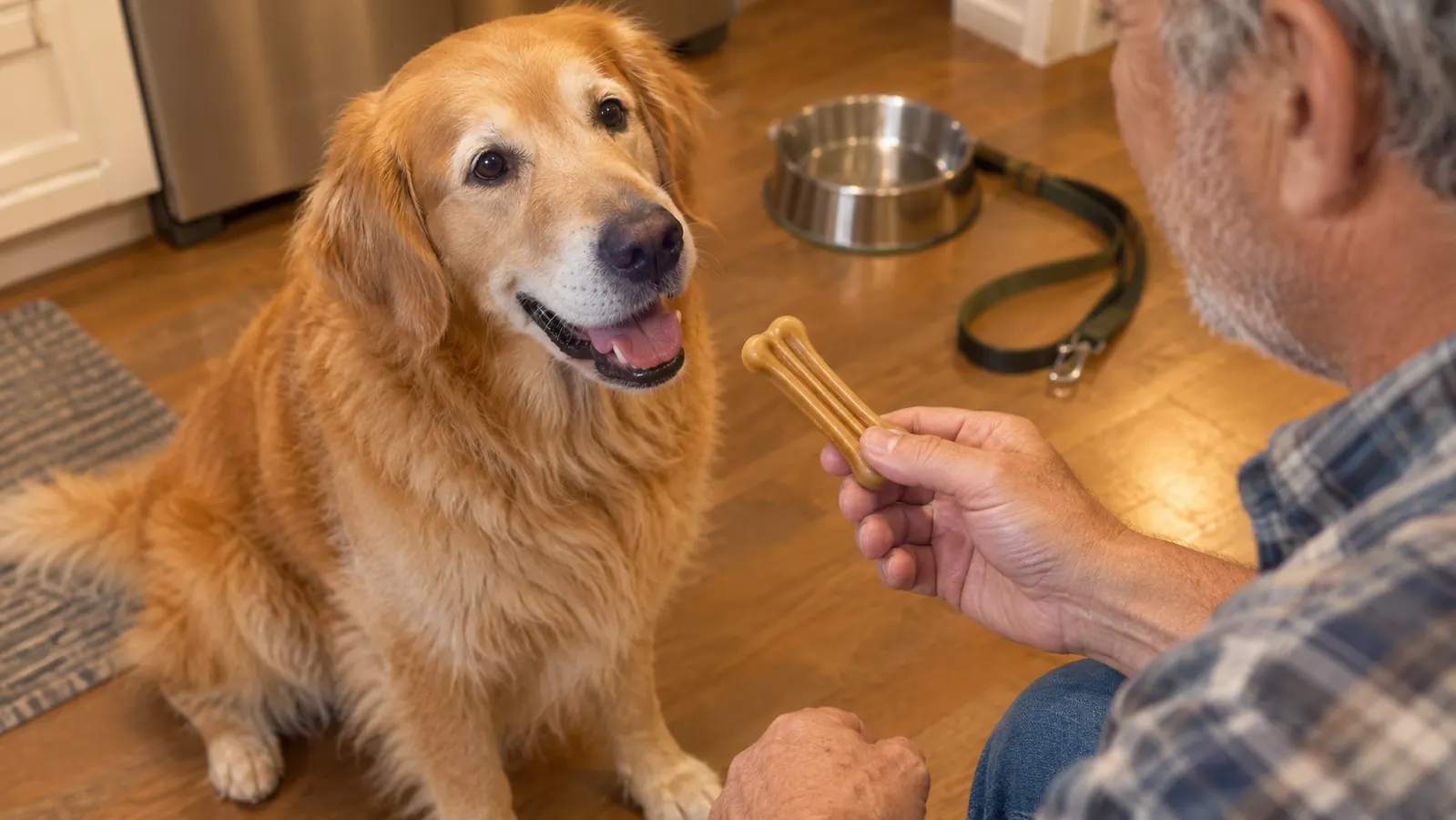
The routine has not changed in a year and a half. We do our slow mile on the trail by the French Broad, we come home, and Rosie gets one chew. She carries it to the rug in the living room and works on it for a few minutes. I stay in the room and I watch her until it is gone.
The watching is not optional in this house. Rosie is a Labrador mix with a Labrador's opinion about food, and she has swallowed things in a hurry that she should have chewed. A chew that goes down whole does nothing for the teeth and is a real hazard for a dog her size. If I have to leave the room, the chew waits on the counter until I am back. She does not love this arrangement. She has learned to live with it.
I also count it. Whatever the pouch lists for calories, this is a treat, and a dog Rosie's age does not need a daily extra that goes uncounted. I feed her a slightly smaller dinner than I used to and her weight has held steady at 68 pounds across three vet visits. That steadiness is the only number on the subject I actually trust.
Before the chew, I tried other things, in roughly this order. A dog toothbrush, twice, which Rosie tolerated for about four seconds before she started backing away from me in the hallway whenever I reached for that drawer. A finger brush with poultry flavored paste, which she liked the taste of and which got maybe three teeth cleaned before she lost interest and walked off. A dental spray I bought at the pet store in Asheville that was supposed to go on her back gums, which is a two-person job and I live alone. None of those were bad products. All of them asked more of both of us than we were going to give on a Tuesday night in February. That is the honest reason a chew won in this house. It is the only thing on the list that does not require her cooperation beyond opening her mouth.
Her routine has a winter shape and a summer shape. In summer she takes the chew out onto the back porch and works on it in the shade, and I sit on the step with my coffee and listen to the crickets. From about November through March she takes it to the rug in the living room, which is one of the few soft surfaces in a house that is otherwise hardwood. That is also where the non-slip socks come into it, because she is not steady on bare hardwood in the cold. Getting up from the rug after a chew takes her a second longer than it did two years ago. I have learned to just wait and let her find her feet.
Her breath went from something I could smell from across the living room to something I have to lean in to notice.
What Eighteen Months Changed, and What It Didn't
Changed, and quickly: the breath. I noticed inside of three weeks that she could sit beside me on the couch and I was not turning my head away. Changed, more slowly: the look of her back teeth. At the checkup last spring Dr. Patel said the tartar on the outer surfaces of the back teeth was lighter than the year before, and she said it in the flat, unexcited voice she uses when something is working but is not a headline.
That checkup was in late March, and it follows the same shape every year. She lifts the lip on both sides, works a fingernail along the upper back molars, and says what she sees. The March before the chew started, she said tartar, and suggested I think about a daily dental chew along with the yearly exam. This past March she said lighter, and then she said the part I keep coming back to, which was that whatever I was doing, keep doing it, because the gum line was going to decide whether Rosie needed a cleaning under anesthesia sooner rather than later. I am 67 and I live alone and a dog going under is not a small thing in this house. That one sentence did more to keep me buying Greenies than anything printed on the pouch.
Did not change: the tartar along the gum line, where the chewing simply cannot reach, and the plaque on the inside surfaces of her teeth. Did not change: her need for the yearly exam and whatever cleaning Dr. Patel decides is warranted from it. The chew is a daily habit that makes the professional work easier and possibly less frequent. It is not a substitute for it, no matter how the pouch reads.
Did not change either: her hips. I bring this up because I have read reviews that credit these chews with everything from fresher breath to a better spring in the dog's step, and that second one is nonsense. Rosie's stiffness is arthritis in her hips, managed with a joint supplement Dr. Patel approved and the non-slip socks she wears on the hardwood. A dental chew has nothing to say about any of that. If your dog is slowing down on the stairs, a chew is not the fix and you should be talking to your vet about the real thing.
The Part Nobody Mentions: Size Selection Is Everything
These come in several sizes and the size chart is printed on the package. Large is for 50 to 100 pound dogs. I have watched people buy the next size up thinking it lasts longer, or the size down thinking it is gentler, and both are mistakes pointing in opposite directions. Too large and a smaller dog cannot get its back teeth into the chew at all, so nothing gets cleaned. Too small and a big dog swallows it in one motion.
I nearly got this wrong the first time. The pouch I picked up was labeled for 50 to 100 pounds, which was right, but the shelf beside it held a box of the next size down and I stood there for a while trying to work out which was the smarter purchase. That arithmetic is a trap. A chew that is too small for a 68 pound dog with a Labrador's jaw is a chew that goes down in one swallow, and I have spent enough evenings watching Rosie to know exactly how fast that happens. I put the smaller box back on the shelf.
Larger is not the safe direction either. I have watched a smaller dog try to work a Large chew and get nowhere with it, nibbling at the end like it was a piece of furniture. The teeth that need the cleaning are the ones at the back, and a dog has to be able to get the chew between them to get anything out of it at all. Size is the one part of this product where the package is telling you something true and specific, and it is worth actually reading instead of grabbing whatever is closest to your hand.
If your dog sits right on the line between two sizes, ask your vet which way to go. That is not a clever answer, it is just the true one. Rosie lands near the middle of the Large range and the chew is a sensible mouthful for her, gone in a few minutes of steady work rather than in seconds.
Sized for the Middle of the Range: 50 to 100 Pounds
Rosie is 68 pounds and Large fits her exactly. If your dog lands near a boundary on the size chart, call your vet before you order rather than guessing.
Amazon See the Size Chart on Amazon →
Brushing, Chews, and the Order I'd Rank Them
If you want my honest ranking of the three things available for a dog's teeth, here it is. Brushing, done properly, is first and it is not close. A veterinary cleaning is second, and it is the only one of the three that gets under the gum line. A daily dental chew is third. Third is not nothing. Third is the only one of the three that actually happens in this house every single day.
That is the whole argument for Greenies in one paragraph, and it is also the honest limit of it. A thing you will do beats a thing you will not do. I have bought two toothbrushes for Rosie over the years and both are in a drawer in the hall bath. The chew gets used, and a used chew beats an unused toothbrush every time.
What I'd Want to Know Before Buying
One pouch holds 24 chews, so a once-a-day habit empties it in a little over three weeks. I buy on a schedule now instead of waiting to see the bottom of the bag, because the stretch where I ran out and did not reorder is the stretch where I learned something.
What I learned is that the breath comes back down when you stop. It took a couple of weeks last fall, and by the end of that gap she was back to being a dog I could smell from the doorway. The back teeth did not visibly get worse in that window. The breath did. Restarting the habit was harder than starting it the first time, which surprised me.
The pouch itself is a stand-up resealable bag, and the seal is the part that gets tired first. One went slack on me after a few weeks of opening and closing it twice a day, and the chews near the top dried out at the edges. Rosie did not seem to mind. I did, because a chew that snaps instead of bending is a chew that a big dog can break a piece off of. Now I stand the pouch upright in the pantry rather than laying it flat, and I press the seal across with my thumb instead of dragging it shut. Small thing. It got me to the end of the bag without a single hard one.
The original flavor smells like a poultry dog treat, meaning it smells like something a dog wants and something you will notice for a minute after the pouch is open. It has not stained the rug or the dog bed. It does leave a greasy mark if it sits on a paperback, which I learned the hard way and which is my own fault for leaving it on the floor.
What I Liked
- Rosie's breath improved within about three weeks and stayed improved
- The tartar on her back teeth looked lighter at the late March checkup
- Rawhide-free, which matters for a dog who had trouble with rawhide
- 68 pounds sits squarely inside the Large range, so the fit is not a guess
- She takes it as a treat with no coaxing at all
Where It Falls Short
- Wheat flour is the first ingredient, so it is wrong for a wheat-sensitive dog
- Needs supervision for any dog that gulps its food
- 24 chews per pouch go fast on a daily schedule
- Does nothing for the tartar that forms under the gum line
- It is a treat, so it counts against the day's food
Who This Is For
Greenies Large suits a dog between 50 and 100 pounds who chews properly, who will be watched while working on a chew, and whose teeth are basically sound with some tartar on the outer surfaces. It suits the owner who is not going to brush, and I would rather admit that about myself than pretend otherwise. It also suits a household that wants something simpler than a rawhide roll and softer than a bone, especially with a big dog who has already proven he will swallow things he should not.
Who Should Skip It
Skip it if your dog swallows treats without chewing. Skip it if your dog has a broken tooth, a missing tooth, or a mouth that is sore to the touch, because a chew is the last thing a sore mouth needs. Skip it if your dog has reacted badly to wheat before, since wheat flour leads the ingredient list. And skip it if your dog has heavy tartar or visibly inflamed gums, because that dog needs a veterinary exam and probably a cleaning first. A chew is maintenance, not treatment.
Skip the Large size if your dog weighs under 50 pounds. That is not a judgment about your dog, it is what the size chart says, and the chart exists because the wrong size is the most common way this product goes wrong. Buy the size that matches your dog's weight, and if your dog has any ongoing health condition, run the whole idea past your vet before you start. That is what I did, and it is the only reason I can tell you any of this with a straight face.
Eighteen Months In, I'm Still Buying It
One chew after the evening walk, watched the whole time, counted as part of the day's treats. That is the entire routine, and it is why Rosie's breath stopped being a topic in this house.
Amazon Check Today's Price on Amazon →