
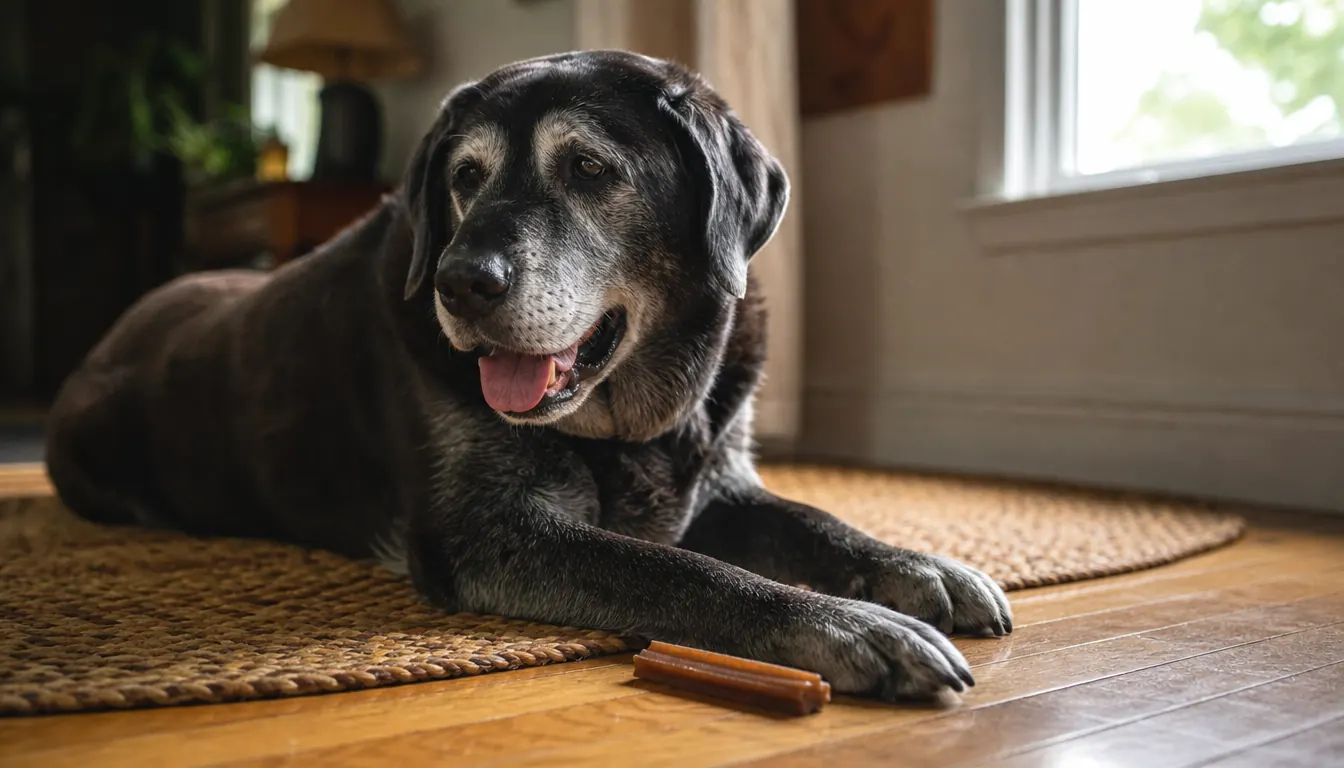
Rosie is nine, about 68 pounds, a yellow Labrador mix I adopted from the county shelter when she was two. At her age-eight checkup, Dr. Patel worked a finger along her back molars, paused, and said the word tartar. Not a crisis. Not yet. But the kind of thing that gets worse quietly while you are not looking, the same way her hips got stiff while I was busy telling myself she was just slowing down.
What she did not say was to buy something and forget about it. What she said was that the tartar along the gumline on her upper back teeth was building, that some of it would need to come off at her next dental cleaning, and that between now and then I could slow the accumulation at home. That is the whole honest frame. You are not removing tartar with a product. You are reducing how fast it forms, and you are keeping the gums from getting angry in the meantime. So this is the routine I actually run, five steps, in order of how much they matter. Greenies Large dental treats are one of those steps, not the entire plan, and I will be specific about which is which.
The chew Rosie gets after her evening walk, every single night
Greenies Large is sized for dogs 50 to 100 pounds, and it is the one dental chew I have kept in the rotation for about 18 months without a break. It is a tool that supports the routine below, not a replacement for brushing or for your vet's dental exam.
Amazon Check Today's Price on Amazon →Step 1: Get a real diagnosis before you buy anything
The most useful thing I did cost nothing and involved no product at all. At that checkup I asked Dr. Patel to show me exactly where the tartar was and to tell me how bad it was on a scale she uses. The answer mattered. Tartar above the gumline on the outer surfaces of the back teeth is the kind a home routine can influence. Tartar below the gumline, or heavy buildup with red, swollen gums, is not something a chew fixes, and pretending otherwise delays the cleaning that would actually help.
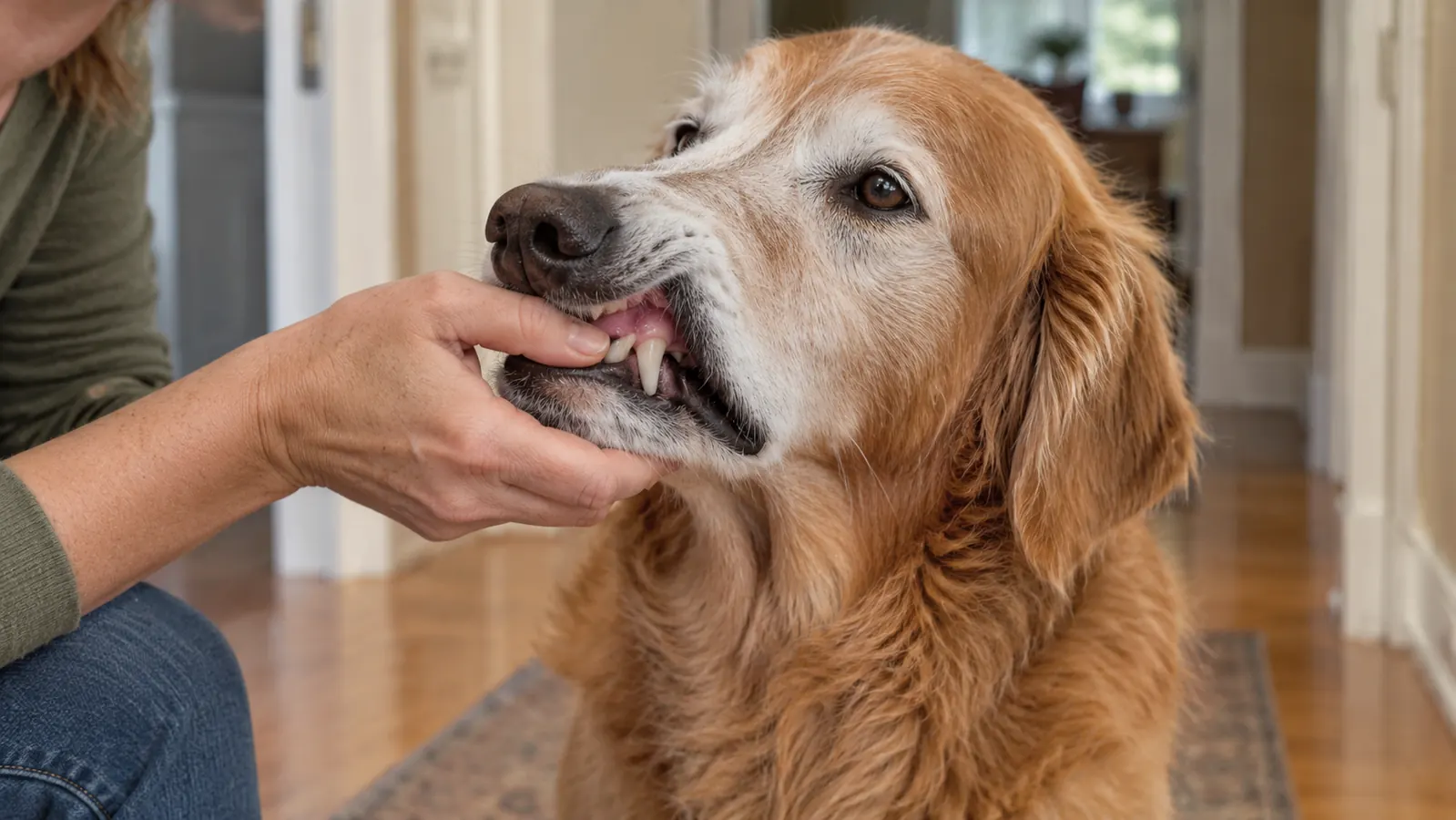
I also asked her to turn the exam light toward me so I could see it myself. She did, and it was obvious once she showed me: a brown line riding along the gumline on the upper back molars on both sides, like a stain that would not scrub off. I had been looking at that dog's face for six years and had never once lifted her lip that far back.
I also asked what she wanted to see at the next visit. Her answer was plain: less accumulation on those upper back molars, and gums that were not inflamed. That gave me something to check against. Without it, every product I tried would have felt like a success because Rosie seemed fine, and dogs are extremely good at seeming fine.
Ask yours the same questions. Ask where the tartar is, how much there is, and whether the gums are involved. Ask if there is any reason a chew would be a bad idea for your dog specifically. That last one matters and I will come back to it, because not every dog should have one.

Step 2: Brush the teeth you can reach, most days
I am not going to pretend this is easy or that I do it perfectly. Rosie tolerates it. That is the honest word. I use a soft dog toothbrush and a pet toothpaste, and I get the outer surfaces of the back teeth and the canine teeth on both sides, maybe 45 seconds total, most nights. The inner surfaces get what they get, because she is not opening wide for me and I have decided not to turn this into a wrestling match she will start avoiding.
What failed first was a finger brush. I bought one, put the toothpaste on my finger, and got about two seconds of contact before Rosie backed her head out of my hands and gave me a look that said we were not doing this. Gauze wrapped around a finger was worse. The soft long-handled brush worked because I was no longer up in her face. The angle was better and she could see what was coming.
What I learned from my own working life, twenty-odd years of helping people move again after injuries, is that consistency at a low intensity beats intensity at low consistency almost every time. A short brush most nights does more than a thorough one every ten days. If your dog will only give you ten seconds, take the ten seconds and stop while it is still pleasant. Build from there.
Brushing is the step that actually disrupts the plaque film before it hardens. Plaque is soft and comes off. Tartar is plaque that has mineralized, and once it is hard you are not brushing it away at home. That is why the brushing has to happen before the hardening, which means frequently, which is the entire difficulty.
Step 3: Add one dental chew a day, and count it
This is where Greenies comes in. Rosie gets one Greenies Large dental treat after her evening walk, every day, and has for about 18 months, starting right after that checkup. The large size is made for dogs 50 to 100 pounds, which fits her at 68. It is a stick form, original flavor, rawhide-free, with no artificial flavors per the listing, and it is the abrasive action of chewing that does the work on the outer surfaces of the teeth.
The first thing I tried was not Greenies. I bought a box of plain hard biscuits marketed for teeth, and Rosie crunched them in about thirty seconds flat, which told me they were not abrading much of anything. A chew needs to take real time. The Greenies stick takes her four or five minutes, which is roughly the window where the chewing is actually doing something at the tooth surface.
The part nobody tells you is that a dental chew is a treat, and treats are calories. I count it as part of her daily intake and adjust elsewhere, because a 68-pound dog with mildly arthritic hips does not need extra weight. I also watch her while she chews. Not because I distrust the product, but because any chew can break into a piece a dog tries to swallow whole, and a dog who gulps is a dog who should have a smaller size or a different approach. Greenies makes smaller sizes for exactly that reason.
What I can tell you after 18 months is narrower than what the packaging promises and more useful. Her breath is noticeably better. At her most recent checkup, Dr. Patel said the back teeth looked cleaner than she expected. The tartar is still there. It is slower. That is the realistic outcome, and I would rather tell you that than sell you a fantasy.
Step 4: Keep the water and the checkups boring
Two things I do almost nothing to maintain, and both matter. Fresh water, changed daily, in a bowl I actually wash. A dog's mouth is a wet environment and a stale bowl is a small daily insult. The other is the yearly exam with a dental look, which is the only part of this routine that catches what home care cannot see.
I want to be careful here, because there is a version of this article that treats the vet visit as the backup plan. It is not. It is the primary plan, and everything at home is the support. Dr. Patel is the one who decides whether Rosie needs a cleaning under anesthesia, and the one who can see under the gumline. In 18 months of daily chews, my job has been to make her next look a little less eventful, and to show up.
If your dog's breath turns sharply bad, or the gums look red or bleed when you brush, or your dog starts dropping food or pawing at the mouth, that is a call to the clinic rather than a reason to buy a different chew. I would say the same thing about any product in this routine.
Step 5: Give it eight to twelve weeks before you judge it
The temptation with anything dental is to check after four days, see no change, and conclude it does not work. Tartar accumulation is slow and so is any change in it. I gave the routine a full stretch between checkups before forming an opinion, and the opinion I formed was modest and specific: better breath fairly quickly, cleaner-looking back teeth at the next exam, tartar present but reduced in pace.
At about the twelve-week mark I did a real comparison instead of going on a feeling. I took a photo of her right side teeth in the same light and at the same angle, then set it beside the one I had taken on the day we started. The change was not dramatic and I would be lying if I said it was. The brown line was narrower. That was the whole difference, and it was enough to keep going.
There was one thing I did not expect. The daily chew became the easiest part of the routine. Brushing takes a decision every night. Handing Rosie a Greenies after her walk takes none. Of the five steps here, it is the one I have never once skipped, and a step you never skip is worth more than a better step you skip half the time.
You are not removing tartar with a product at home. You are slowing how fast it forms while the gums stay calm. Everything else is marketing.
What Else Helps
A few smaller things that fit around the five steps. Dental wipes are useful on a dog who will not tolerate a brush, and they are better than nothing, though not better than a brush. Water additives exist and I have not used one, so I will not pretend to have an opinion. Some people swear by a raw bone or a bully stick for chewing abrasion; my worry there is fracture, especially on a dog Rosie's age, and Dr. Patel has seen enough cracked teeth that I stay with products designed for the job.
The other thing that helps is not dental at all. A dog at a healthy weight has less strain everywhere, and a dog whose hips are managed is a dog who moves better and gets chewed more thoroughly because she is comfortable. Rosie has been on a joint supplement for about a year for the mild arthritis in her hips, and the two routines live in the same evening: walk, chew, brush, bed. Bundling them is how any of it survives a winter.
Finally, know your dog's mouth. Once a week I lift Rosie's lip on both sides and look. Not diagnose, look. I know what her teeth looked like at the last checkup and I know what changed. That weekly ten-second habit is what would catch a problem between annual visits, and it costs nothing.
Who This Routine Is Not For
If your dog is a gulper, a chew like this needs supervision or a smaller size, and I would not leave one with a dog who eats fast and swallows without chewing. If your dog has fewer teeth, a painful mouth, or a history of dental surgery, ask your vet before adding any chew. If your dog has food sensitivities, read the ingredient list, which includes wheat flour and gelatin, and check with your vet. And if your dog already has significant tartar, red gums, or loose teeth, a chew is not the answer and a dental appointment is.
One chew a day, sized for a dog 50 to 100 pounds
Rosie has had hers after the evening walk for about 18 months, counted as part of her daily treats, and always alongside brushing and her yearly exam. If your dog is a large breed and your vet says chewing is fine, this is the one I keep buying.
Amazon Check Today's Price on Amazon →