
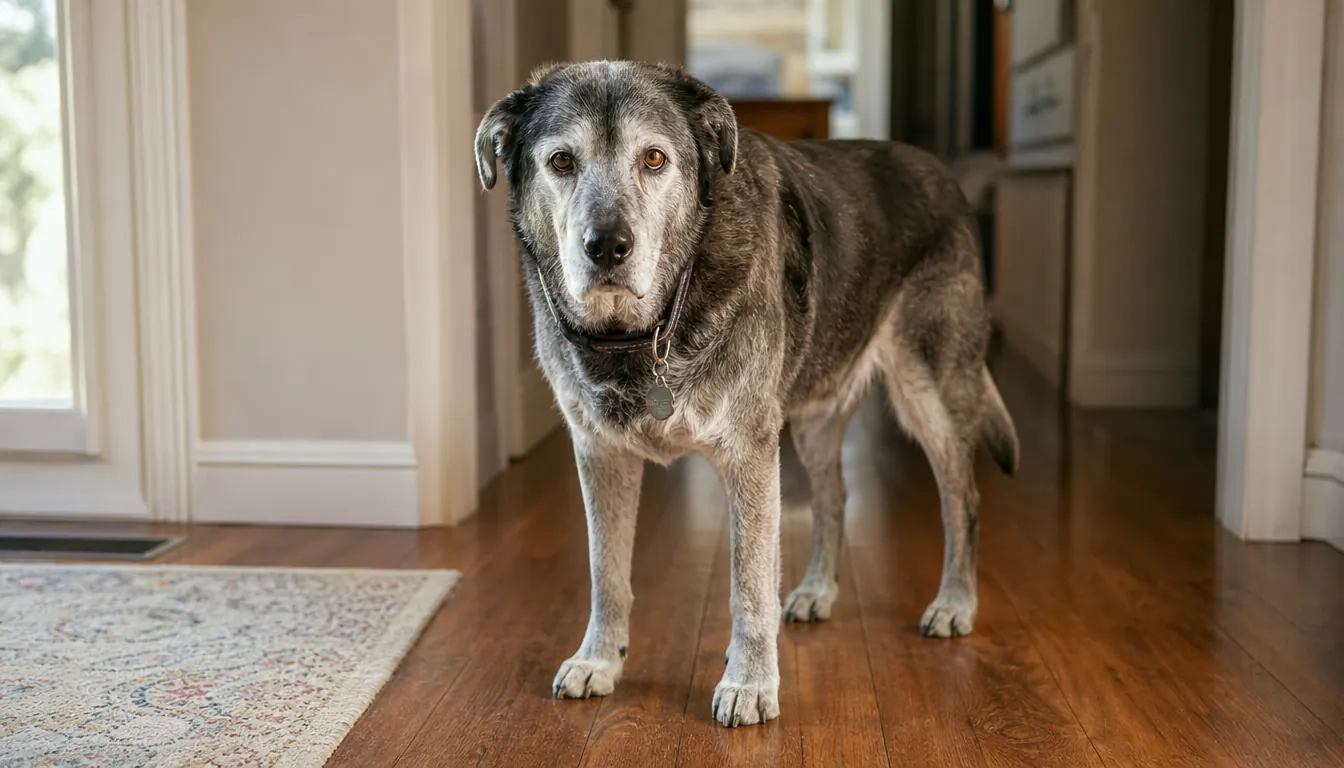
The sound is specific. It is not a bark or a whine. It is four paws trying to get traction on oak and losing, a quick scrambling scratch, and then a heavy thump as sixty-eight pounds of yellow Labrador mix sits down hard on her back end. Rosie did it twice in one week in the hallway last winter, and the second time she turned her head and looked at me as if I had built the floor wrong. She was nine. Her hips had been stiff in the mornings for a year by then, the mild arthritis Dr. Patel found at her age-eight checkup, and a hardwood hallway is unforgiving to a dog who cannot push off the way she used to. I am not a vet. I am a retired physical therapy aide, which means I spent thirty years watching people learn to trust a leg again, and I recognized the look on her face.
What finally fixed it was a set of DOK TigerToes non-slip socks in size Large, plus four changes to the house that took me one Saturday. The socks are the part people ask about, and I will get to them in detail. But the order matters, and the steps ahead of the socks cost nothing but attention. What I tried first did not help at all. I laid a bath towel in the hallway and the towel slid further than she did. I looked at rubber boots, and the pairs snug enough to stay on were stiff and heavy, close to the last thing a stiff-hipped dog needs when she is only trying to cross a room.
The half second between a stumble and a fall
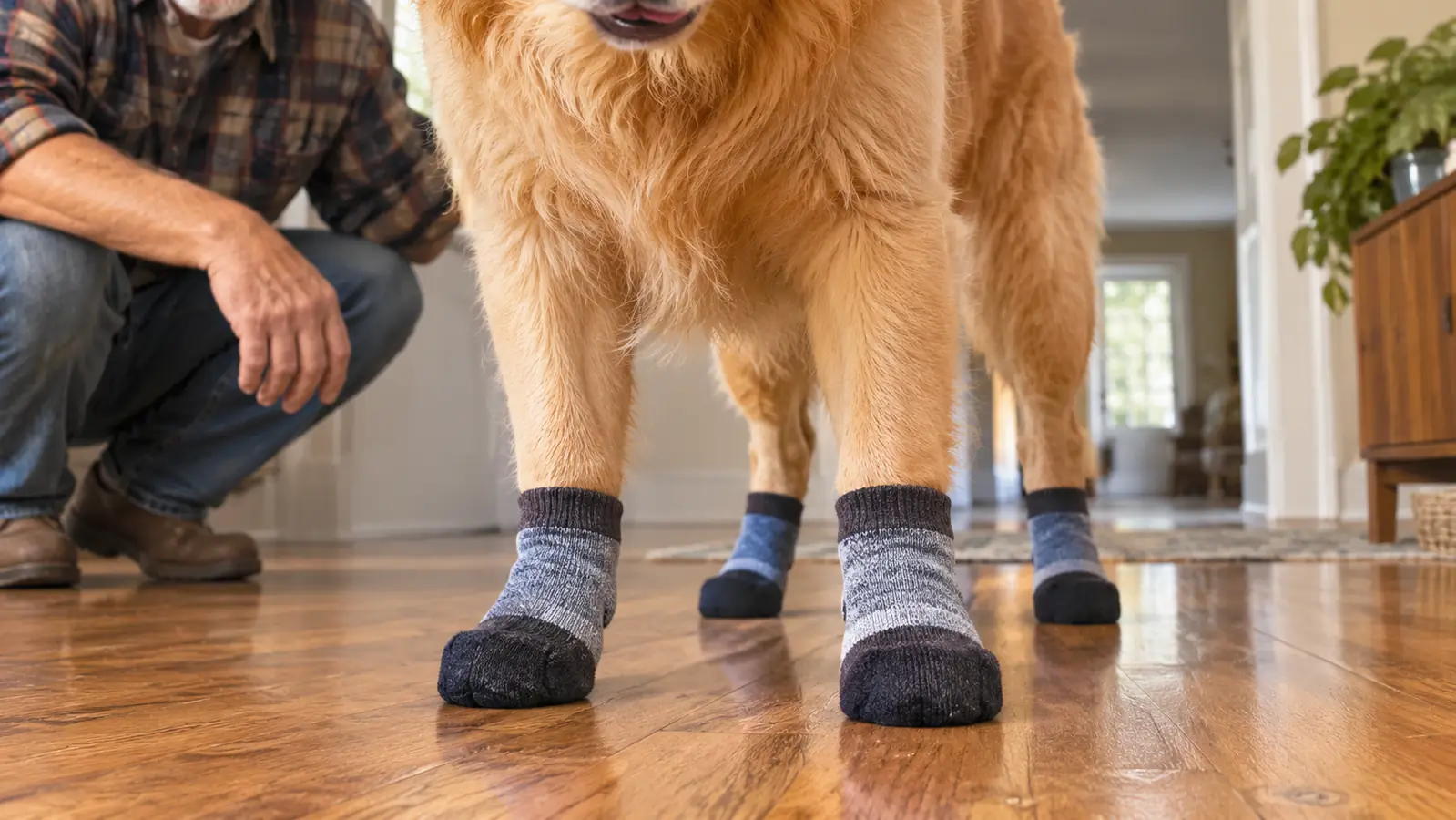
Rosie wears DOK TigerToes indoors on the hardwood, size Large for paws measuring 2.5 to 2.8 inches. Four socks to a set, cotton and nylon, machine washable, with a grip built to hold even when the sock twists underfoot. She has not gone down in the hallway since.
Amazon Check Today's Price on Amazon →Step 1: Find the three or four places the floor is actually beating her
A dog does not slip everywhere in the house. She slips where she turns, where she accelerates, and where she arrives with damp paws. Watch for one full morning instead of guessing and a pattern shows up fast. In our house it was the turn at the end of the hallway, the two feet of bare oak between the kitchen and the living room rug, and the threshold where she comes in from the back yard. The bedroom, fully carpeted, has never been a problem. Nothing has ever happened to her on carpet.
I marked those spots with strips of painter's tape and left them down for a week. It sounds fussy. It is not, because the marks keep you honest about how much bare floor she crosses in a day. By day four I had six strips down and a much clearer idea of what I was solving. If you live in a one-story house like mine, most of those spots will sit within thirty feet of each other, which makes the whole fix smaller than it feels.
The other thing to watch is how she moves, not just whether she falls. A dog with sore hips shortens her stride, takes the inside of a turn, and starts avoiding the slick stretch altogether by hugging the rug edge. Rosie had been doing all three. She lost the hallway long before she fell in it, and I did not notice until I wrote it down.
Step 2: Shorten the nails and clear the hair between the pads
Here is the part that surprised me, and I should have known it after thirty years of watching feet. The pads are the only part of a dog with real grip. Long nails lift those pads off the floor, so the dog is walking on keratin instead of on the textured part of the foot. If you can hear your dog clicking down the hallway like she is wearing tap shoes, the nails are long enough to be costing her traction. Rosie's were clicking. Our vet's technician showed me where the quick sits and how much is safe to take, and now I do a small amount every three or four weeks instead of one big session twice a year.
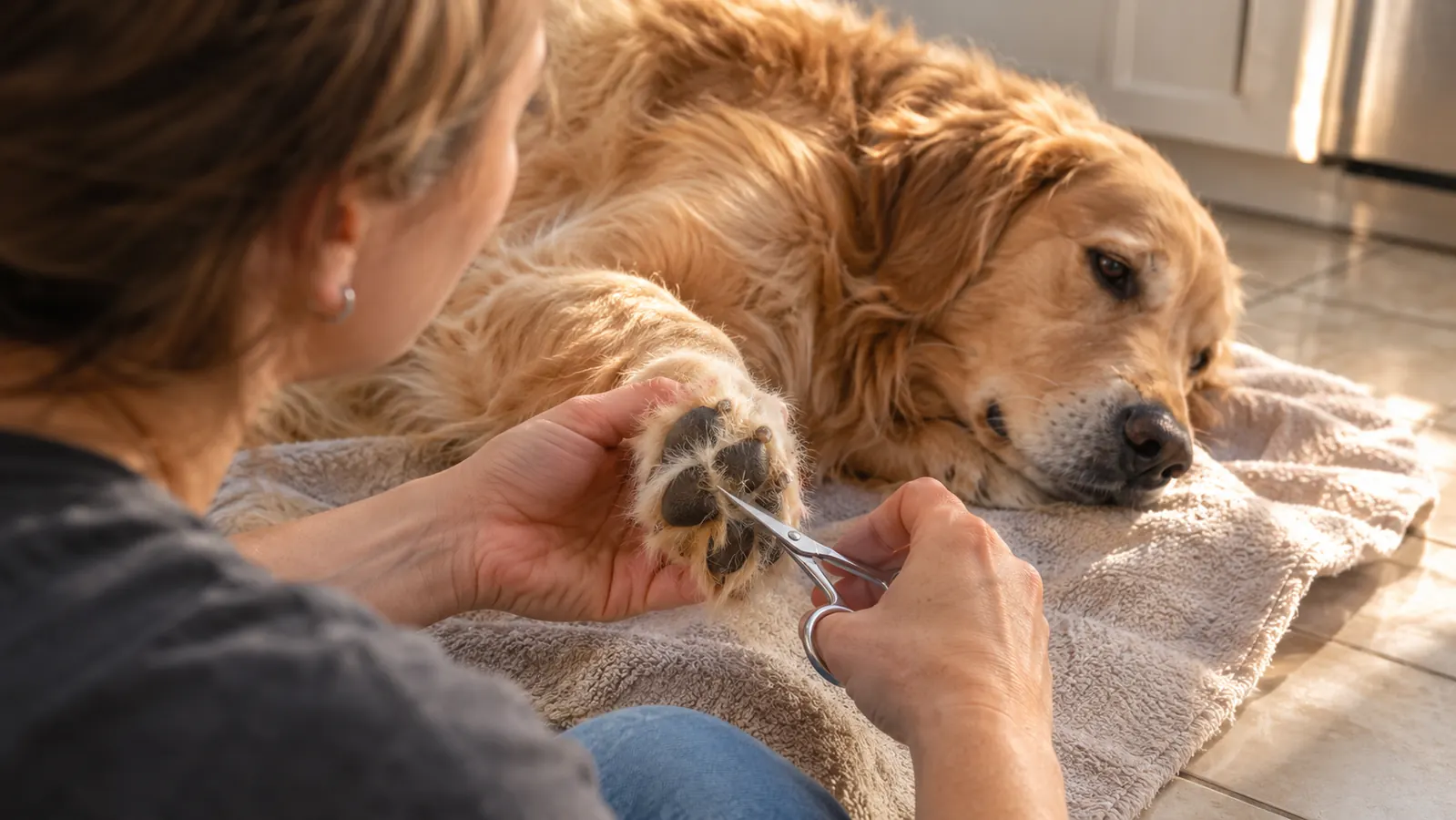
The hair between the pads matters just as much and gets talked about less. On a Labrador mix it grows out and packs into a felted mat that covers the pad entirely, and a mat of hair on oak has about as much grip as a wool sock on a waxed floor. I trim it flat with a small pair of rounded scissors, working with the blade against the pad rather than pointing down into it. A groomer will do it in five minutes if you would rather not.
One warning, because this is the step where people get hurt. The skin between the pads is thin, and a dog will not hold still if the scissors pinch. If she pulls her foot away, stop and book the groomer. There is no prize for doing it yourself. I do Rosie's on a towel on the kitchen floor with a smear of peanut butter in a bowl to keep her head busy, and I still only do one paw per sitting.
Step 3: Put rugs where she turns, not where you think she walks
The instinct is to buy one big rug and call it done. What worked better was a runner down the length of the hallway, a mat at each door she uses, and a small rug at the bottom of the porch steps. The runner matters most because it covers the turn. The door mat matters second because damp paws on smooth wood have almost no grip at all, and a September morning in the mountains is damp more often than not.
Two rules. Every rug needs a thin rubber non-slip pad underneath, and a rug that slides is worse than bare floor because the dog steps onto something that moves under her. Second, watch the edges. A curled corner is a trip hazard, so press it flat or tape it until it settles. I brought two runners home in the back of the Outback, cut them to length on the porch, and had them down before lunch.
You do not have to carpet the house. You have to break up the long slick runs and give her something to push off at the two or three places she changes direction. If money is tight, do the hallway turn first and the doorway second. Those two alone changed Rosie's mornings.
Step 4: Measure the paw and fit DOK TigerToes properly
The measurement is the whole thing. Put the dog on a hard floor, stand her up, and measure across the widest part of the front paw with her weight on it. Do not measure a lifted paw, because a lifted paw is narrower than a standing one and you will order small. Rosie measured inside the Large range, which DOK lists as 2.5 to 2.8 inches, and the Large fits her. Each set includes four socks. If your dog lands between sizes, go up and check the fit rather than squeezing a paw into the smaller one.
The socks go on as a pull-on, and then the hook and loop closure fastens over the top of the foot to hold them in place. What I did not expect was the twisting. A dog's foot rotates as she walks, and the sock-style grips I looked at before this one put traction on the bottom only, so a quarter turn left her walking on plain fabric. The DOK grip is built to hold even when the sock rotates underfoot. In practice that means I straighten a sock now and then instead of chasing her down the hall to redo one.
The first week was not elegant. She pulled one off with her teeth twice, both times within ten minutes, and I put it back on without making a production of it. By the end of the week she had stopped bothering. She wears them indoors on the hardwood in the mornings and the evenings, never on walks and never overnight, and I run them through the machine once a week with a load of towels. Two things to check each time: that the closure is snug without digging in, and that no hair is caught under it.
Step 5: Keep a short routine, and know what the socks cannot do
The routine that has held for us is unglamorous. Socks on before she gets off her bed in the morning, on again after her afternoon nap, off for the slow mile by the French Broad, off for the night. It takes about thirty seconds each time once the dog stops treating it as an event. Two weeks in, she was standing still for it without being asked.
Then there is the maintenance side, which is where most people drift. Nails every three or four weeks. Hair between the pads at the same time. Rug edges checked for curling. Socks checked for a worn grip patch or a closure that has stopped holding. A sock that has started to rub shows as a pink spot on the top of the foot, so look at the feet when you take them off, not just at the floor.
And here is the honest limit. A sock does not fix arthritis and it does not fix a neurologic problem. If your dog is knuckling over onto the top of her foot, dragging a back paw, or crossing her hind legs when she stands, that is a call to the vet before it is a call to the pet store. What the socks do is narrower and real. They steady the foot on a slick surface long enough for her to catch herself. That is the difference between a dog who crosses the kitchen and one who decides the kitchen is not worth it.
A sock does not fix arthritis. What it buys is the half second she needs to catch herself before her back end goes down.
What Else Helps
Traction is one part of a bigger picture. Weight is the part nobody wants to hear about. Every extra pound on a dog with sore hips is a pound she carries up the porch steps, and Dr. Patel has been direct with me about keeping Rosie near sixty-eight rather than letting her drift up. The other free lever is daily movement, short and regular rather than long and occasional. Our slow mile on the flat trail does more for her than a weekend of anything more ambitious.
Beyond that, the things already in the house did their part. Rosie has been on a glucosamine and chondroitin chewable since that age-eight checkup, at the amount the label lists for her weight, after I confirmed it with Dr. Patel. It helped and it did not cure anything, which is what I expected. If your dog's stiffness is new, or has been getting worse over a few weeks, get it looked at. Traction and a supplement are support. They are not a diagnosis.
Start with the hallway, not the whole house
Measure the standing paw, order the size that matches, and give the first week some patience. DOK TigerToes in size Large fits paws from 2.5 to 2.8 inches, four to a set, machine washable, worn indoors on the wood and off for walks and sleep.
Amazon Check Today's Price on Amazon →