

Rosie starts scratching in late July, right around the time the humidity settles over Hendersonville and decides to stay. Same thing every year. She gets up stiff in the hips, and by August her flanks are pink and she is chewing at her back feet on the living room rug while I pretend not to notice. Last summer I finally asked Dr. Patel the question I should have asked three summers earlier. Was there anything simpler than adding another pill to the pile?
That is how a bottle of Native Pet Omega 3 ended up next to the coffee maker, which is the only counter space I reliably walk past at six in the morning. Eight ounces of wild salmon and pollock oil with a pump on top. I started it last July at the amount the label lists for her weight, two pumps per twenty pounds, and I confirmed that number with Dr. Patel before the first squirt hit her kibble. I worked her up to the full amount over about a week so her stomach had a chance to object. Two months later her coat had a shine it had not had since she was four. The scratching got quieter. Not gone. Quieter. Here is what I think each part of that is worth.
The one bottle that earned permanent counter space
Wild salmon and pollock oil, two pumps per twenty pounds, one pump bottle. It is the least dramatic thing in my kitchen and the one Rosie notices first.
Amazon Check Today's Price on Amazon →Two wild-caught fish sources instead of one
Native Pet blends wild-caught Alaskan salmon oil with wild-caught pollock oil, and the label is plain about both. I care about that because salmon and pollock are not the same fish and do not carry the same fatty acid profile. One source is a single note. Two is closer to a chord. I am not a nutritionist and I will not pretend I can rank them. What I can tell you is that a company naming both sources and their origin usually means the oil is the product, not an afterthought behind a flavoring.
The fatty acids work on the skin barrier, not the itch itself
The listing says the omega 3 and 6 fatty acids support a healthy skin barrier and skin comfort. That phrasing is worth sitting with. A barrier that holds moisture is a barrier that does not let in quite so much of whatever sets a dog off in the first place. That is slow, structural work. It is not a switch you flip. Which is exactly why I would not expect a different dog in week one, and why I would not buy this expecting it to replace anything Dr. Patel prescribes for allergies.
The dose is written per pound, so it moves with the dog
Two pumps per twenty pounds of body weight, daily. That is the label. I like it because the amount scales with Rosie and not with the bottle, and because a pump is a pump, not a scoop I have to level off with a butter knife while a Labrador breathes on my wrist. Your dog's number is your business and your vet's business. Read the label, ask the clinic, and do not take mine.
One pump bottle beats a pill and a pill pocket
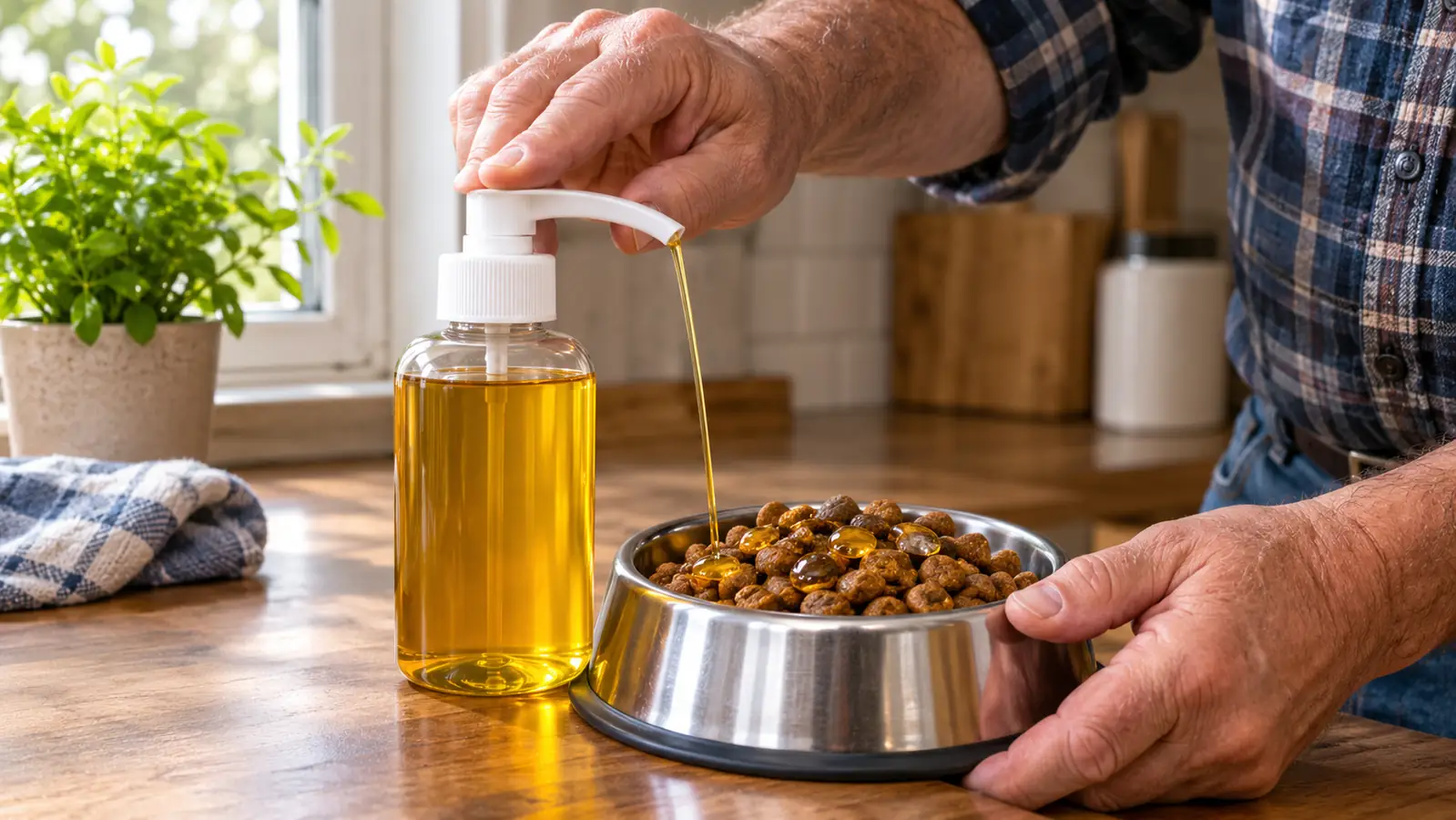
The eight ounce bottle comes with the pump included and lives on the counter without taking up real estate. Rosie takes her joint chew like a treat, but I have known dogs who can find a capsule inside a wad of cheese from across the room. Oil over kibble has no hiding place to defeat. Two pumps, a quick stir with the back of the spoon, done before the coffee finishes dripping.
The shine shows up before anything else does
Around two months in, I noticed it in the hallway light. Her coat along the shoulder and down the flank had that sheen back, the one a yellow dog gets when everything is running right. Nobody told me to look for it. It was just there. If you want a single early signal to watch for, that is mine. Take a photo on day one and another at eight weeks, because memory is a poor measuring stick and I have talked myself out of changes before.

Less scratching in late summer, not a silent August
I want to be careful here. Rosie still scratches in August. The itch season still arrives, the way it always has, and there are evenings she works at one spot on her ribs until I put a hand on her and she stops. What changed is the volume. Fewer bouts, shorter ones, and her skin does not look as angry when I part the fur to check. That is a real improvement and it is not a cure, and I would not trust anyone who told you otherwise.
It fits in with what she already takes
Rosie is on a joint supplement with breakfast and a probiotic when her stomach misbehaves. Adding the oil did not require a new ritual or a new time of day. It goes on the same bowl at the same meal. If you are already juggling two or three things for an older dog, you know the thing that gets skipped is always the thing that needs its own separate ceremony.
The fish smell is real and the dog disagrees
It smells like what it is. I keep the bottle capped, I wash my hands after, and my kitchen briefly smells like a fish market on a Tuesday morning. Rosie thinks this is the best development in years and now supervises breakfast from about a foot closer than she used to. If you have a strong opinion about fish, know that going in. It is the only real complaint I have about the product itself.
It gives you something specific to bring to the vet
This is the part I did not expect to matter. The next time Rosie's itching came up at the clinic, I had something concrete to say. Started in July, this amount, coat improved by September, scratching reduced but present. Dr. Patel could work with that. Vague reports of a dog who seems itchy produce vague advice. A timeline and a product name produce a conversation. Skin problems are often more than one thing, and your vet is the one who can sort that out.
It is small enough that you will actually keep doing it
Most of what fails at my house fails because it is a production. This is two pumps and a spoon. A bottle lasts long enough that I am not reordering every other week, and the habit folded into a routine I already had. For an older dog with a nagging problem, boring and repeatable beats impressive and abandoned. That is true of the joint chew, it is true of the dental treat, and it is true here.
What I'd Skip
I would skip anything that promises this will replace a vet visit or end itch season entirely. I would skip starting at the full amount on day one, because a dog's stomach has opinions and easing in over a week cost me nothing. I would skip buying three bottles before you know whether your dog tolerates it. And I would not tell you Native Pet is the only option on the shelf, only that it is the one I have used long enough to describe honestly. If your dog's itching comes with hair loss, open sores, vomiting, or a sudden change in appetite or energy, that is a clinic call, not a supplement decision. Dr. Patel has caught things in Rosie I would have explained away as age.
The coat changed before the scratching did. That order matters to me, because it told me something was happening under the surface before I could see the point of it.
Two pumps a day is a fair test of any idea
Eight ounces of wild salmon and pollock oil, taken at the label amount for your dog's weight, with your vet in the loop. Give it eight weeks before you decide. Take the before photo tonight.
Amazon Check Today's Price on Amazon →