

Rosie started scratching in the third week of July, right on schedule. She is a 9-year-old yellow Labrador mix, about 68 pounds, adopted from a county shelter when she was two, and every late summer the itch moves into her flanks, the base of her tail, and the soft spot behind her front legs that she can reach with her back teeth if she works at it. By August I was sweeping up tufts of undercoat every morning and hearing her collar jingle at two in the morning.
I had already been through the usual rounds. A medicated shampoo that smelled like road tar and left her skin looking worse. A store-brand chew that promised a glossy coat and delivered nothing I could see. Two food switches, one of which is the reason there is a box of probiotic sachets in my pantry to this day. What I had not tried was a plain fish oil, which is a strange thing to admit for a man who spent thirty years telling people to take care of their joints and keep moving. So last July I bought an 8 ounce pump bottle of Native Pet Omega 3 and started working it into her breakfast. This is the honest version of what happened over the months since, including the parts that disappointed me.
The Quick Verdict
Eight months in, the coat is visibly smoother and the evening scratching has mostly stopped, but the seasonal itch still arrives in July. This is a good daily supplement, not a treatment for allergies. Ask your vet before the first pump.
Amazon Check Today's Price →The change in Rosie's coat did not come from a shampoo
An 8 ounce pump bottle of wild-caught salmon and pollock oil. The label serving is 2 pumps per 20 pounds of body weight, and I confirmed the amount for her weight with our vet before the first one went on her kibble.
Amazon Check Today's Price on Amazon →How I've Used It
The label gives the serving as 2 pumps per 20 pounds of body weight daily. Rosie is 68 pounds, so I worked her number out from that, called the clinic to confirm it, and wrote the total on a sticky note inside the cabinet door so I would stop doing arithmetic at six in the morning with a dog breathing on my wrist. Dr. Patel's one note was to ramp up slowly instead of starting at the full amount, because a sudden load of oil will loosen some dogs' stools. That was the whole conversation and it took four minutes. I have since passed the same advice to two neighbors, one with a German shepherd and one with a beagle, and both of them got the same answer from their own vets: start low, watch the stool, call back if something goes sideways.
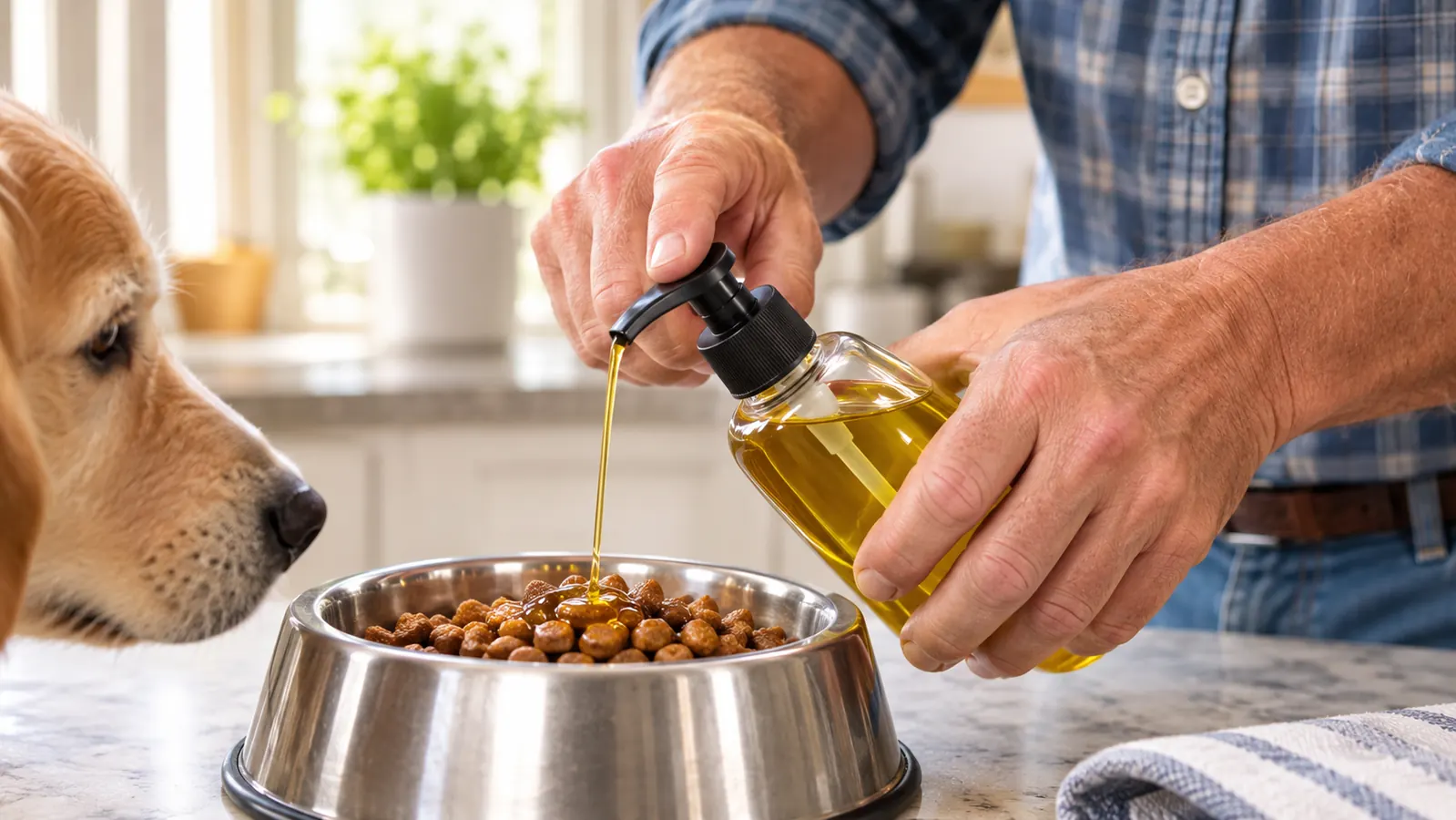
So the first week was half. I pumped that over her kibble at breakfast, stirred it in with a fork so it was not sitting in one spot, and watched. Rosie is not a fussy dog, but she is a suspicious one. She stood over the bowl for a good ten seconds sniffing before she committed. It smells like a fish market. She did not care. She has never cared, and she has since licked the bowl clean enough that I could put it back in the cabinet.
By the second week she was on the full amount and her stools were unchanged, which was the entire point of going slow. The Native Pet bottle lives on the shelf next to her food bin, pump side up, away from the light coming through the kitchen window. One 8 ounce bottle carried me a little over two months at her serving. That is the arithmetic nobody puts on the front of the label: this is not a year's supply for a large dog, it is a standing order. I write the date I open a bottle on the cap with a marker, because otherwise two months go by and I cannot tell you when it started.
What's Actually in the Bottle
The active list is two fish, not ten things. Wild-caught Alaskan salmon oil and wild-caught pollock oil, and the listing describes it as two wild-caught fish sources with zero fillers, which matches the panel on the Native Pet bottle sitting on my counter. The omega 3 and 6 fatty acids in those oils are what support the skin barrier, and the skin barrier is the thing that gives out when a dog chews herself raw every August. That is the whole mechanism. It is not glamorous, it is just the part of the body that needs raw material to rebuild itself, the same way a knee needs blood flow and time after a replacement. Nobody sells that story because it takes weeks.
Salmon gets the attention. Pollock does the quiet work. Both are cold-water fish and both carry the long-chain omega 3s. Using two sources means the bottle is not leaning on one supply chain. I am not a nutritionist and I am not going to pretend I can tell you the ratio matters more than giving it every single day without skipping. In my experience with Rosie, consistency is the whole variable.
The pump is worth its own paragraph, because it is the difference between a supplement you use and one that sits in the door of the refrigerator until it turns. The bottle is 3 by 2.2 by 5.75 inches and 8 ounces, so it takes a corner of a shelf without a fight, and one press delivers a measured amount instead of a glug. I have had oil supplements in a squeeze bottle before. Half of one ended up on my counter and the other half on my shoe. With a pump I can dose her one handed while holding the bowl steady with the other, which matters more than it sounds like it should when there is a 68 pound dog leaning on your leg.
The First Two Months
Nothing happened for three weeks. I want to be clear about that, because every review of every supplement reads like the change was visible by Thursday. Week three, week four, week five: same dog, same scratching, same jingle at two in the morning. On the first of August I was sitting on the porch with her at my feet, running my hand down her back and feeling that dry, slightly stiff coat, and I had already decided I would finish the Native Pet bottle and not reorder. I told my daughter as much on the Sunday phone call. She said give it another month. She was right and I was wrong, which she will enjoy hearing about for years.
Somewhere in the sixth or seventh week I noticed my hand. I pet her the same way every morning, a flat palm from her shoulders down to her tail, and the coat had gone from dry and slightly coarse to something smoother. Not glossy like a show dog. Smoother. The kind of difference you notice with your hand before you notice with your eye, which is how I have judged every soft tissue change in my life. The shedding on the hardwood was lighter too. I was sweeping every other day instead of every day.
By the end of the second month she was scratching less in the evenings, and that one I can actually measure, because the evening scratch used to be a routine. She would eat dinner, then go at her left flank for ten or fifteen minutes on the rug while I read. That routine mostly stopped. It comes back on bad days. It is not gone.
The coat had gone from dry and slightly coarse to something smoother. The kind of difference you notice with your hand before you notice with your eye.
The Itch Season Still Shows Up
Here is what the oil did not do. It did not end the seasonal itch. The summer I started, I was already behind the curve, and the itch ran its usual course. The next July came around with the oil in her system from the start, and it still showed up, right on time, base of the tail first. What changed was the severity and what I had to do about it. The summer before, I was on the phone to the clinic by the second week of August. This past summer I got through the season on the oil plus a weekly bath with the oatmeal shampoo Dr. Patel recommended, and I called once, in the second week of September, about a hot spot the size of a dime under her collar. That visit was a cream and a cone and a bill, and it was still less than the summer before.
That is a real improvement and I am not going to inflate it into more than it is. Itchy skin in a dog this age is usually several things stacked on top of each other: dry air, pollen, whatever is growing in the yard, and a skin barrier that is not holding up its end. Fish oil addresses the last one. It does nothing about the first three. If your dog has an ear infection, a bald angry patch, or is chewing herself bloody, that is a vet visit, not a supplement, and you should not spend six weeks finding out.
I also want to say the obvious thing about a fish oil and a sensitive stomach, since Rosie has one. Going slow was the whole game. When I got impatient in the third month and gave her the full amount at dinner instead of breakfast, on a night when she had also had her dental chew and a little of my chicken, her stool was soft the next morning. One data point, and enough to send me back to breakfast and to keeping the rest of her day boring.
What I Liked
- Two named fish sources, salmon and pollock, with zero fillers on the ingredient panel
- The pump delivers a measured amount, so a large dog's serving is worked out once and then it is the same every morning
- Rosie's coat was noticeably smoother by the sixth week and the evening scratching mostly stopped
- She takes it on plain kibble without a fight, and she is a suspicious eater
- An 8 ounce bottle lasted a little over two months at her serving, so the math is easy to track
Where It Falls Short
- It smells like a fish market, which is fine for the dog and less fine in a small kitchen
- The itch season still arrives. This softens it, it does not prevent it
- Two months per bottle for a 68 pound dog, so this is a standing order and not a one-time buy
- The serving has to be calculated for your dog's weight and confirmed with your vet
- No visible change at all for the first three to five weeks, and some people quit before then

How It Fits With the Rest of Rosie's Routine
Rosie is on several things and I keep them straight because I have to. Cosequin for her hips, which Dr. Patel suggested after her age-8 checkup showed mild arthritis. One dental chew after her evening walk, for the tartar. A probiotic sachet on dinner when her stomach goes sideways, which is rarer now than it was last spring. And the oil on breakfast. None of these overlap in a way that worries me, but I had the clinic look at the whole list before I added the oil, and I would do the same before adding anything else to it.
The Native Pet oil goes on breakfast and not dinner for a reason. Breakfast is kibble, plain, and she eats it fast. Dinner is where the extras live. Keeping them separate means that if her stomach turns over, I know which meal to blame. It also means the fish smell is a morning thing, which is a small mercy in a one-story house with the windows shut in January.
The last piece is the hardwood, and it has nothing to do with fish oil except in the way everything connects with an old dog. Rosie's back legs splayed on the hallway floor last winter, which is how we ended up with non-slip socks for the mornings and evenings. A dog with a better coat and less itch is a dog who moves more comfortably, and a dog who moves more comfortably on a slick floor is a dog who needs traction. The supplement helps her skin. It does not help her footing, and I would not want anybody reading this to think it does.
Who This Is For
An older dog with a dull coat, dry skin, and a seasonal itch that returns every year, where your vet has already ruled out the things that need actual medicine. A picky or suspicious eater, because the oil disappears into the kibble and there is nothing to spit out. A household willing to give it daily for two months before deciding, because that is roughly how long it took here. And someone who already keeps a note on the cabinet door and a vet on speed dial. If that is how you run things, this fits the way you already work.
Who Should Skip It
Skip it if your dog is chewing herself raw, has an ear infection, or has a bald angry patch. Go to the clinic first. Skip it if your dog has pancreatitis or any condition where your vet has told you to watch fat intake, because this is oil and that conversation belongs to your vet and not to a retired physical therapy aide in Hendersonville. Skip it if you want a fix rather than a supplement, because that is not what this is. And skip it if you will not give it consistently. The sixth week is when it started to matter for Rosie, and six weeks of a bottle sitting in the cabinet does nothing at all.
Eight months in, the bottle is still on the shelf and it will get reordered
An 8 ounce pump bottle of wild-caught salmon and pollock oil. Work out the serving from the label for your dog's weight, confirm it with your own vet, and give it eight weeks before you judge it.
Amazon Check Today's Price on Amazon →