

The first thing I noticed about Native Pet Omega 3 was not her coat. It was the smell. I unscrewed the cap on a July afternoon, pumped it over Rosie's breakfast, and the kitchen smelled like a fish counter for the rest of the morning. Rosie is a nine-year-old yellow Lab mix with a sensitive stomach and a habit of gnawing at her back legs every August, and she did not care about the smell at all. She licked the bowl clean and looked up at me for more. I stood there holding a bottle I had just bought and wondering what we had gotten into. That was last July. She is still on it. What follows is the version I would give a neighbor across the fence, including the parts the product page does not dwell on.
The Quick Verdict
By week eight her coat had a sheen it had lost years ago and the night scratching eased. It did nothing for her hips, the smell is real, and the pump quits before the bottle does.
Amazon Check Today's Price →If August has you buying oatmeal shampoo by the case, start with the bowl instead
Wild-caught salmon oil and pollock oil, two pumps per twenty pounds of dog, and a pump bottle that lives on the counter next to the food bin.
Amazon Check Today's Price on Amazon →Rosie turned nine in March. At her age-eight checkup our vet, Dr. Patel, noted mild hip arthritis and a little tartar, and we started her on a joint supplement and a daily dental chew, both of which have earned their place in this house. The itching is a separate problem, and it runs like a calendar. Late July she starts nibbling at her flank. By mid-August she is up at night, thumping the floor with a hind foot, and I am awake listening to it in the dark. I had tried the oatmeal shampoo, the wipe-downs after our slow mile on the walking trail by the French Broad River, and a vacuum cleaner with a better filter. None of it hurt. None of it changed much either. Dr. Patel said a fish oil was a reasonable thing to try alongside everything else, so I ordered Native Pet Omega 3 and gave it a fair run rather than a fair-weather one.
What Nobody Warns You About Before the First Pump
The smell is the first thing, and I want to be straight with you about it. This is not a faint, pleasant fish note. It smells like the inside of a bait shop on a warm day. When I pump it onto her kibble the oil coats the food and clings to the bowl, and if I set the pump down on the counter without thinking there is a fishy ring there an hour later. I have learned to pump directly over the bowl with a paper towel underneath and to wipe the nozzle before I set the bottle down. Her breath for about twenty minutes after breakfast is not something I would bring up at the table. It fades. But if fish smell in your kitchen is the kind of thing that gets under your skin, this will be a daily negotiation, not a minor annoyance.
The texture surprised me. It pours thick and slow, more like the oil in a tin of sardines than the thin yellow stuff I expected. On dry kibble it soaks in and darkens the food. Rosie does not mind that at all. A pickier dog might. My daughter's dog turns her nose up at anything with a strong scent, and I would not bet a nickel on her eating this straight.
Then there is the pump. The first several presses did nothing but push air, which is normal for a new bottle and still makes you wonder whether you got a dud. Once it caught, it delivered a steady squirt every time. The nozzle stays tacky between uses, and if I leave the bottle lying on its side in the cabinet it weeps onto the shelf. Standing upright on the counter beside her food bin, it behaves itself. Those are small things. Over months, small things are what decide whether you keep using something or quietly stop.
How I've Used It
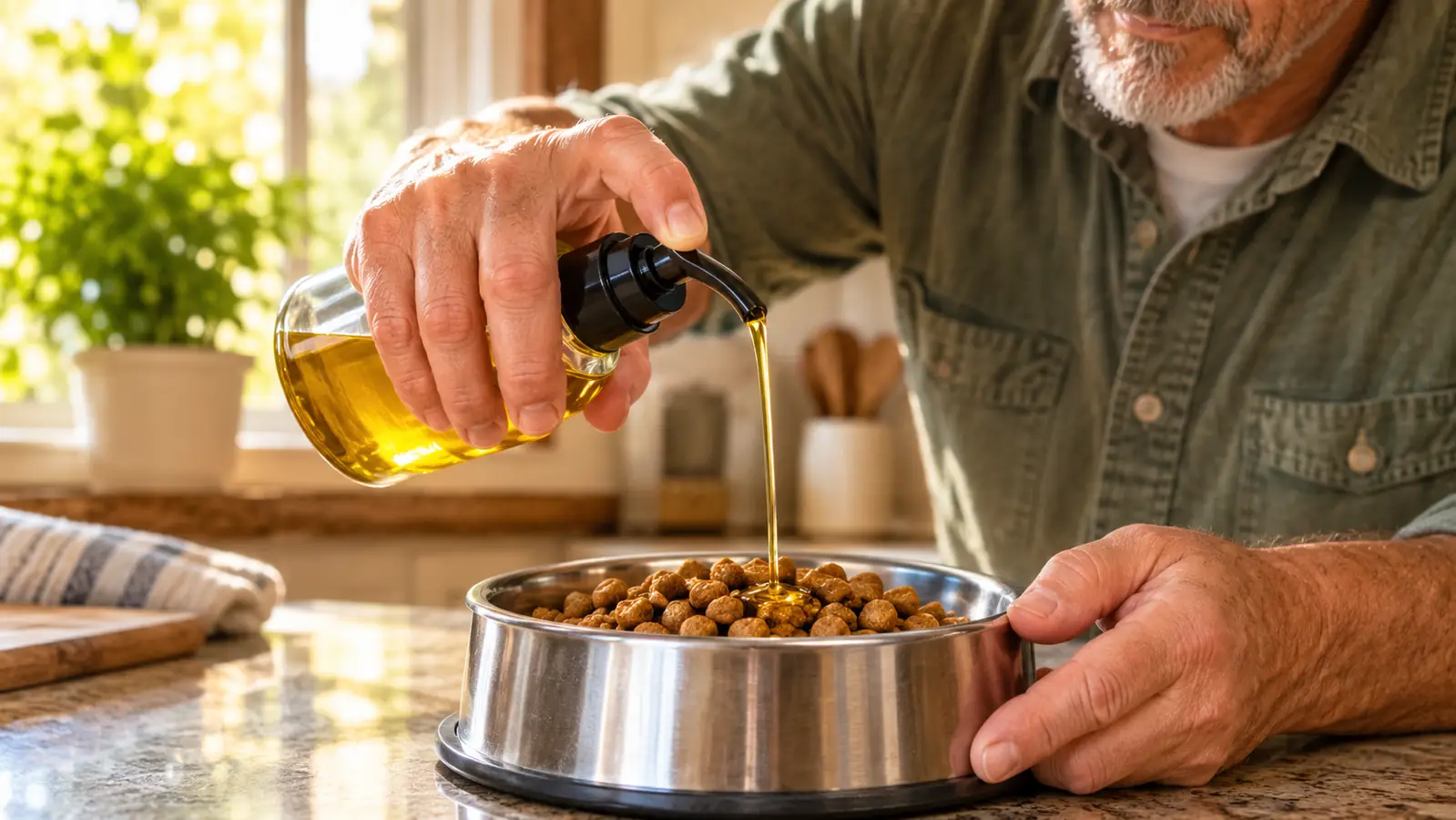
The label calls for 2 pumps per 20 pounds of body weight, and the label is where I stop when it comes to numbers. At 68 pounds that worked out to just under seven pumps a day, which is more oil than it sounds like. I did not start there. I started with two pumps on her breakfast and added roughly one pump every other day over about a week, because she has a sensitive gut and I did not want to learn that lesson the hard way at two in the morning. I cleared the whole plan with Dr. Patel first, and I would tell anyone else to do the same. What is right for my dog is not automatically right for yours, and I am not the man to set your dose.
It goes on breakfast, never dinner. That was deliberate. If something is going to disagree with her, I would rather it disagree at seven in the morning when I am awake and dressed than at nine at night when I am not. I stir it through the kibble with a fork so it is not all pooled in one corner, and in January I add a splash of warm water to loosen it up. She eats it the same as she eats everything else, which is to say fast and without comment.
Travel is the one place the routine gets awkward. She comes with me to my daughter's place in Charlotte now and then, and the bottle comes along, upright in a plastic bag in the back of the Outback. It has survived two trips without spilling. A pump bottle riding in a hot car in July is a thing worth thinking about, so it goes in the cooler bag with the rest of her food and I do not leave it on the seat.
The Honest Part: What Two Months Did and Did Not Fix
The first two weeks I noticed nothing. I want to be clear about that, because a review promising a change by day three is not describing the product I bought. Around week three she stopped the night scratching. Not all of it. Enough that I slept through a couple of nights in a row and noticed the difference in the morning. By week eight her coat had a sheen to it that it had lost somewhere in her middle years. The rough patch over her hips, the one that always felt a little dry and flaky under my hand, smoothed out. Her skin looked less angry overall. She still scratched in August. The itch season still showed up, same as always. It just did not run the house the way it did the summer before.
By week eight her coat had a sheen it had lost somewhere in her middle years, and the rough patch over her hips finally smoothed out. She still scratched in August. It just did not run the house.
My daughter noticed before I did. She came through in early September, watched Rosie get up off her bed, and said her coat looked different. That is not a scientific measure. It is the kind of thing you hear from someone who sees a dog every few months instead of every day, and it matched what I thought I was seeing in the hallway light.
What it did not do deserves the same space. Her hips are no better on this oil. That is the joint supplement's job in our house and I never expected a fish oil to take it over. She is still slow off her bed on cold mornings and still careful on the porch steps. Her tartar has not changed and it was never going to. Her weight has not changed. If you are looking at a fish oil to fix a limp, you are going to be disappointed, and whoever sold it to you should have said so plainly.
What's Actually in the Bottle
The label lists two sources: wild-caught Alaskan salmon oil and wild-caught pollock oil, blended for omega 3 and 6 fatty acids. That is the whole of what I can verify. I am a retired physical therapy aide, not a chemist, and I did not send a sample off to a lab. What I can say is that the ingredient line is short, which is the first thing I look at on any label, and that Native Pet does not bury the fish oils under a paragraph of things I cannot pronounce. The listing names skin and coat support, joint health, immune support and heart among the intended uses. In this house it has been a skin and coat product and nothing more.
If you are weighing this against capsules, the honest tradeoff is convenience against mess. Capsules do not smell up your kitchen and they do not leave a ring on the counter. They also get spit onto the floor by a dog who can tell a pill from a treat, and then you are on your knees under the table at seven in the morning fishing around for it. Rosie takes her joint tablet like it is candy. She would not take an oil capsule that way. The pump wins that argument in our house.
What I'd Compare It To
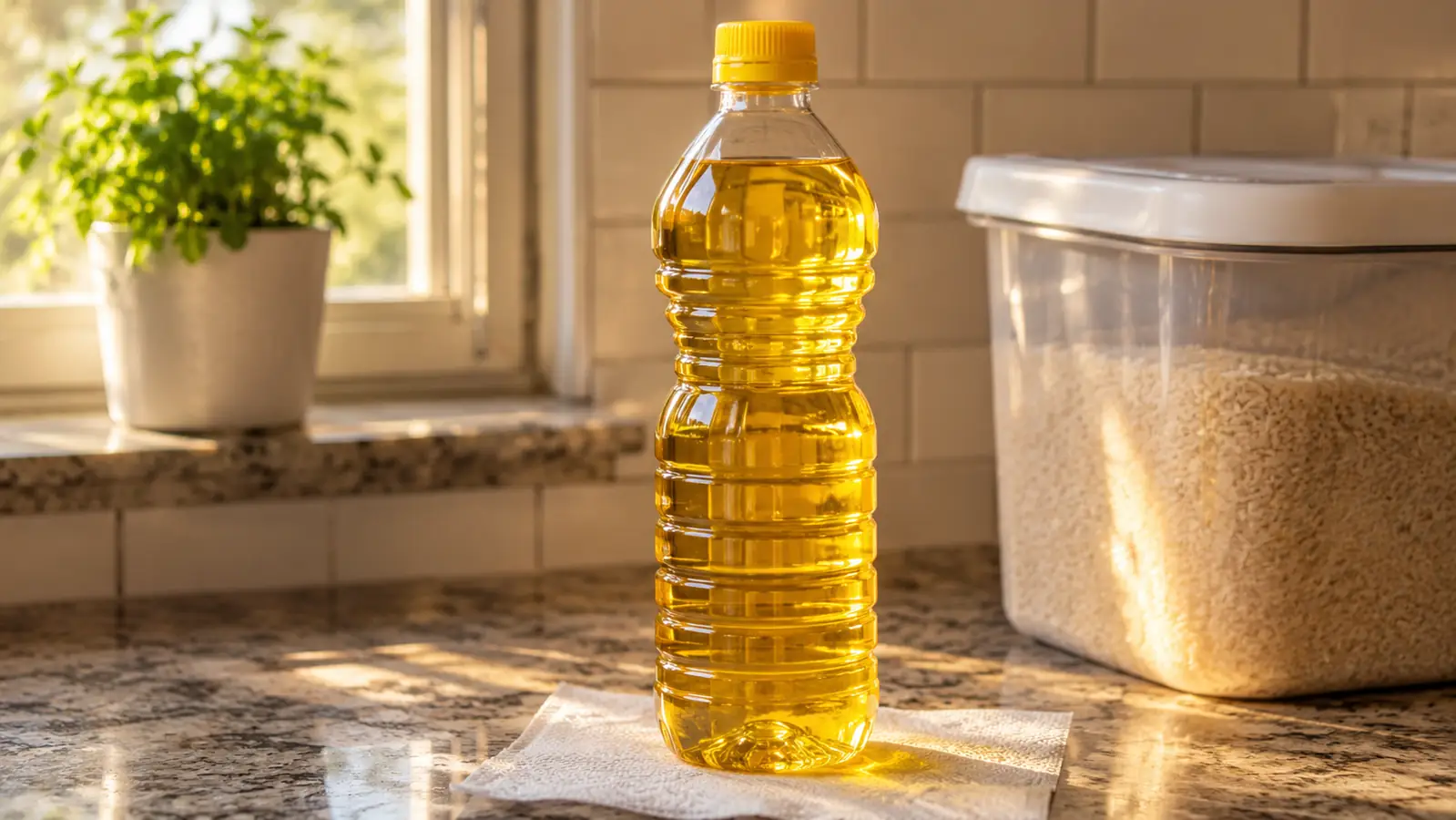
Before this bottle I tried the obvious cheaper route, which was a jug of fish oil from the farm store and a measuring spoon. It was a mess. It went off before I finished it, it dripped down the side of the jug every single time, and I had no real idea whether the amount I was giving her was anywhere close to right. The advantage of something built for dogs is that the label is written for a dog's weight and the pump is sized to match it. The disadvantage is that you are paying for that convenience. I have not run a cost comparison against other bottles and I am not going to pretend otherwise. I will say I stopped shopping around after the second bottle, which is the only review metric that has ever mattered to me.
Her Stomach, and the Week I Almost Stopped
Rosie's digestion is the reason I do everything slowly. Last spring she had a week of loose stool after I switched her food too fast, and Dr. Patel put her on a probiotic powder for a month. So when I added oil, I added it the way I add everything, one small change at a time. Even so, around day six there was one loose stool, and I cannot tell you whether the oil caused it. I backed her down to fewer pumps for three days, then came back up slowly, and it never happened again. If your dog has a touchy gut, plan on a slow ramp and keep your vet in the loop.
I also keep a box of that probiotic in the pantry, and I call the clinic if anything lasts more than a day or two or shows up alongside vomiting or a dog that will not get up off her bed. That is not a fish oil decision. That is just what you do when you live with an animal who cannot tell you what hurts.
The Bottle Is Half the Experience
The bottle is eight ounces, roughly three by two and a quarter by five and three quarters of an inch, and it fits neatly on the counter beside her food bin without taking over the space. The pump really is convenient. I can dose her breakfast one-handed while holding the bowl steady with the other, and I am not standing over the sink with a measuring spoon. Two things to know before you buy. First, the pump does not reach the last of the oil, so the final day or two means unscrewing the top and pouring carefully. Second, an upright bottle is a happy bottle. Laid down, it leaves a ring on the shelf and a sticky patch on the bottle itself. I learned that the way most things get learned in a kitchen.
Eight ounces at her dose went faster than I expected. I found myself ordering a fresh bottle about every five weeks, which is the real arithmetic of a large dog on a daily oil. That is not a complaint about the product. It is a fact about owning a sixty-eight pound dog with a working appetite. If the routine is going to wear on you, it will wear on you here, at the reorder, and not at the first purchase.
Where It Fell Short
I have four honest complaints. The smell, which I have covered and will not soften. The pump that cannot reach the bottom of the bottle. The bottle that weeps if it tips over. And the waiting. Two months is a long time to keep buying something on faith, and there is no way at week two to know whether it is going to work for your dog. There is also no way to know whether the improvement I saw was the oil, the season turning, or simply a dog having a better year. I am one household with one dog, no control group, and no lab coat. Take my experience for exactly what it is worth.
What I Liked
- Her coat came back with a visible sheen by about week eight
- Night scratching eased enough that we both started sleeping
- Pump dosing is faster than measuring spoons over the sink
- Two wild-caught fish sources, salmon and pollock, with a short ingredient line
- Rosie eats it without a fight, which is more than I can say for capsules
Where It Falls Short
- Smells strongly of fish and lingers in the kitchen
- The pump will not reach the last of the oil in the bottle
- Leaks onto the shelf if the bottle lies on its side
- Roughly two months before I could judge whether it helped
- No effect at all on her hips or her tartar
Who This Is For
This is for the owner of a dog with dry skin, a dull coat, or a seasonal itch that arrives every year around the same week. You have probably already done the basic things, the good food and the wipe-downs and the shampoo, and you want one more sensible item in the bowl rather than another bottle of something that smells like a candle. It suits a dog who eats without drama and an owner who can live with a fish smell in the kitchen. It suits someone willing to give it a full eight weeks before deciding, because that is how long it took here.
It also makes sense if you already have a joint supplement going and you are treating the skin and coat as the separate problem it is, which is exactly how I ended up with two bottles on the counter and a small chart on the refrigerator.
Who Should Skip It
Skip it if your dog is a fussy eater who backs away from strong smells, because this is a strong smell and it goes on the food. Skip it if your dog has a diagnosed skin condition, a thyroid problem, or is on medication, and you have not talked to your vet about adding a fatty acid supplement, because these things do interact with other things and I am not the person to sort that out. Skip it if you want something that shows a result inside a week. And skip it if your actual problem is a limp, because this is not a joint product and it will not act like one no matter how faithfully you dose it.
One more. If you cannot keep a bottle upright or you dose in a hurry in a dim kitchen before your own coffee, expect a little mess until the habit sets in.
Two pumps on breakfast, eight weeks of patience, and a dog that scratches less
It will not fix her hips. It did put the shine back in her coat and quiet the August nights. Read the label for your dog's weight and clear it with your vet first.
Amazon Check Today's Price on Amazon →